Monday, June 17, 2019

Selective Data On Communal Violence In India: IndiaSpend, English Media Have A Lot To Answer For


by 


 - 
Recently, American daily Washington Post (WP) carried a report on its website that cites data by Indiaspend to say that "reports of religious-based hate-crime cases have spiked in India since the pro-Hindu nationalist government of Narendra Modi came to power in 2014". IndiaSpend tracks reports of communal violence only in English-language media and WP piece admits as much.
The WP piece isn't an evaluation of English media's reportage of communal violence pre and post Modi, but of communal violence under Modi's prime ministership itself. This is evident from their headline ('Rising hate in India') and the way it narrates select cases to back Indiaspend's conclusion that "Muslims are overwhelmingly the victims and Hindus the perpetrators of the cases reported".
The broad takeaway from the WP report thus is that under the current government, there has been a sharp rise in communal violence, which is increasing by every passing year, and it's mostly the majority Hindus attacking the minority Muslims spurred by religious hatred.
A close look at Indiaspend's data (and thus the WP report), however, reveals that it is deeply flawed and dishonest. The reasons, largely, are these:
1) For its so-called 'hate crime watch' (abbreviated HCW from now on), Indiaspend has chosen its source as the English language media. As is well documented, English media by no means provides a balanced or exhaustive enough reportage to be used for a fair, pan-India analysis. It has also beenshown that English media cherrypicks cases in which the victim-perpetrator equation suits the narratives it has woven all these years, and has disproportionate coverage of some states as compared to others. It thus fares poorly in fairness and scale compared to their regional language counterparts. Swarajya itself has detailed at least three such cases (herehere and here) but perhaps nothing establishes it better than a long-running Twitter thread by author-scientist Anand Ranganathan which has listed over 50 such instances of brazen selectivity and bias.
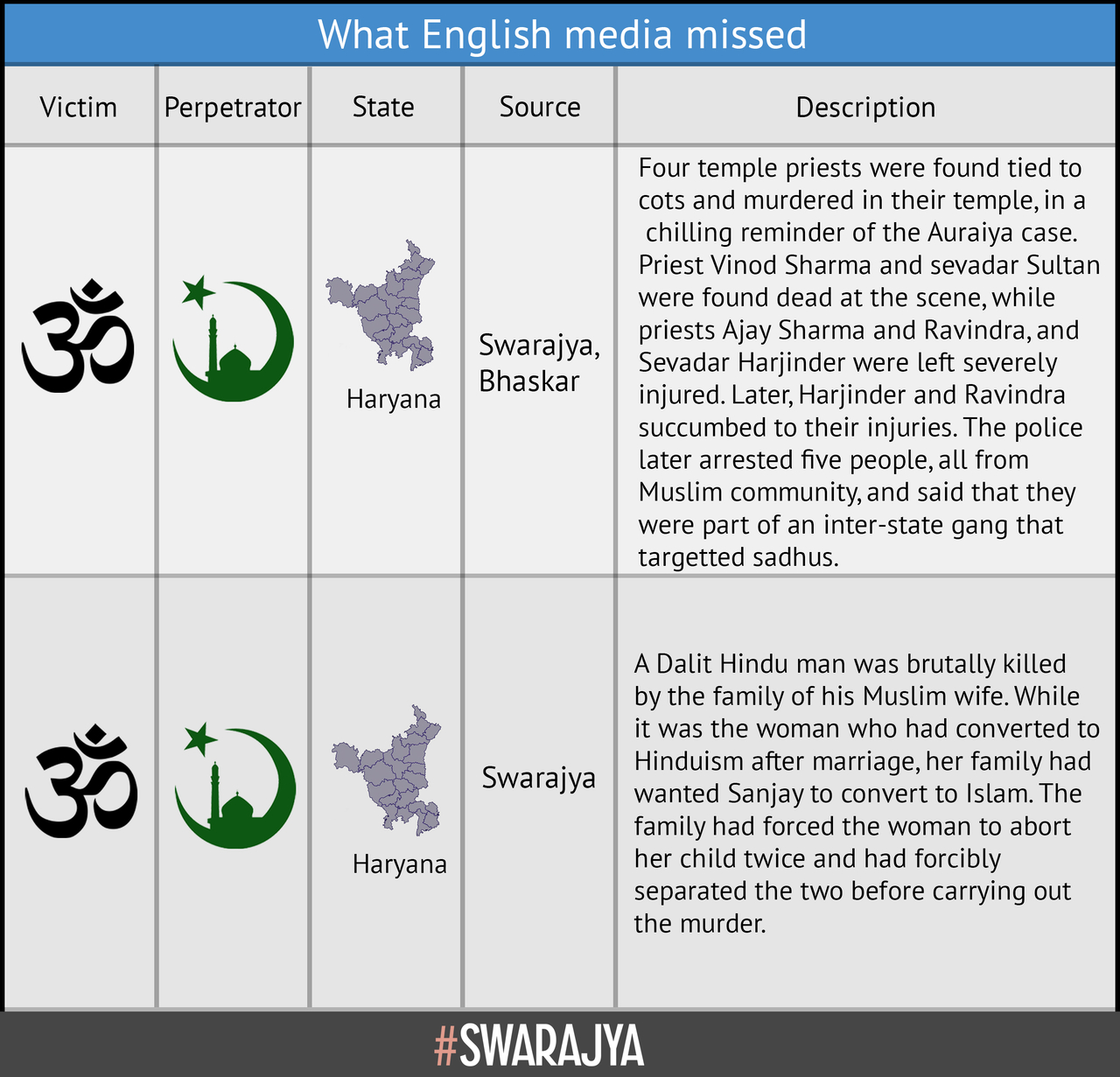
2) The choice of cases by Indiaspend from an already selective source shows blatant bias. As we will document below, Indiaspend has consistently picked up cases where Muslims are victims and Hindus the perpetrators, but has ignored cases where this equation changes. Such is the bias that even the high-profile Auraiya sadhu murders perpetrated by Muslim cow smugglers has been ignored.
3) Indiaspend's conclusion from its selective data, based on an already selective source, has been found to be dishonest. As we will show, there are cases in their database where names of Muslim accused have been held back to conclude that religion of perpetrator is "unknown" (Chandan Gupta case), and cases where perpetrators have been named as Hindus even when the source they cite give no such identity.
We studied Indiaspend's data for six months in 2018 namely January, February, April, May, July and August. For each month, we have compiled cases picked up by Indiaspend and compared it with cases they ignored from English media as well as cases that English media ignored but appeared in Hindi media.

(click on images to enlarge)
January
February
April
May
July
August
If selective picking of cases from English media isn’t enough, Indiaspend has left out inconvenient bits from the selected cases. For instance, for Republic Day violence in Kasganj, Indiaspend has listed three crimes. The first is about "pushing and shoving" where Indiaspend has named Hindus as perpetrators and Muslims as victims. However, their version is not only one-sided but also does not specifically mention who did the pushing and shoving and who was pushed and shoved. Where did Indiaspend get the religion of the victims and perpetrators then?
There’s more. In the episode, one Chandan Gupta was killed and one Saleem Javed was arrested within a week. More arrests, also of Muslim men, happened over the next week. But Indiaspend tracker mentioned the religion of perpetrators as "unknown" until this correspondent highlighted it on Twitter two weeks ago. They explained this miss by saying that "the religion of the alleged perpetrators was not clear initially, and the arrests were made later". But this is, least to say, surprising because in other cases, like Kathua, they have updated the details that were revealed at least three months after the crime.
Another explanation by Indiaspend, which also doesn’t quite add up, is one offered on exclusion of Auraiya sadhus murder case. As per the website, the crime doesn’t belong to their database as “smugglers are motivated by profit and not by hate”. A ridiculous assumption, given that in the alleged lynching of cow smuggler Rakbar Khan, Indiaspend hasn’t considered the possibility that villagers were motivated by love for cow or angered by loss of their cattle as an economic resource, and not hate towards Muslims. After all, even Hindus have been victims of cow vigilantism. Further, what explains Indiaspend including Junaid Khan’s murder in their database when even the court verdict says it was spurred by fight over a seat in a train compartment ?
In the same pattern, their coverage of Ram-Navmi violence in Asansol in March is skewed. Only one out of four casualties has been listed. A day prior to Sitbulla Rashidi's death (that IndiaSpend has recorded), one Chhote Yadav was killed in Ranigunj but his death has been ignored. Also, the source that Indiaspend has cited nowhere states the perpetrators to be Hindus in Sitbulla’s case.
As readers can see, Indiaspend's hate tracker is tailor-made to show Muslims as overwhelmingly the victims and Hindus overwhelmingly as the perpetrators. However, if the cases listed by Swarajya are added to their database, this equation will turn on its head. That said, Swarajya isn't making any claims on our counter data being exhaustive enough to give a fair picture of the hate crimes in India; it has been compiled only to point out serious factual flaws in the former.
Indiaspend's database is routinely cited by a number of media houses to make a comment on religious hate crimes in India. Other than Washington Post, publications like Newslaundry, The Print, Indian Express and The Quint have published a number of articles and commentaries based on this tracker. Interestingly, when this correspondent pointed out some of the above-listed omissions to author of the WP article, Annie Gowen, on social media platform Twitter, she did not respond to any of it. Instead, Gowen derogatorily called this correspondent a "troll" for asking genuine questions. This shows that publications like WP are too pleased with the narrative presented by Indiaspend to even make an attempt to address its fallacies.
Indiaspend's hate tracker follows a similar database created by Hindustan Timesunder its former editor Bobby Ghosh last year. Called Hindustan Times hate tracker, it was touted as "a national database on crimes in the name of religion, caste, race". The HT tracker, again, was found to be deeply flawed and blatantly biased as shown, among others, by Anand Ranganathan. Later when Ghosh resigned (buzz was that he was forced to resign), the tracker was said to be one of the main reasons behind it. The tracker was pulled down soon after he was replaced. However, no explanations for its bias and the quiet way in which it was pulled down, were ever given by Hindustan Times.
Explanation have now been sought by alert readers from other journalists like Barkha Dutt who recently cited the Indiaspend database in a commentary that controversially concluded that Hindus face no institutionalised discrimination and their claiming otherwise is "nonsense". Unlike Gowen, Dutt refrained from calling critics as trolls but escaped questions on flaws in Indiaspend tracker by saying she would check the analysis.
Similarly, when this correspondent asked Newslaundry's editor-in-chief Madhu Trehan about profiling of crime data based on religious profiles by so-called hate trackers, Trehan replied, "I would have to have access to the source of the data, research and investigate it to give you a serious answer. That editors pick data and stories on what they want you to believe is an old fact. Exclusion and inclusion of stories is subjective, always."
Fair point, but Trehan has not explained why Newslaundry has been routinely citing Indiaspend's data in its reports and commentaries without doing the said analysis.
It is high time media houses do that before further spreading falsehoods. Indiaspend itself has much to answer for.
(With inputs from Madhur Sharma)

Sunday, June 16, 2019

Murty’s classical Indian library


January 22, 2015
For those of us whose Sanskrit is not up to scratch, Sheldon Pollock remains an enigmatic figure. Widely lauded as a scholar in Sanskrit, some commentators like Rajiv Malhotra, the US-based author, are harshly critical of his translations, saying they present an Anglocentric view of ancient Indian literature.
That may – or may not – be true. Western scholars of Indology have often distorted Indian religious teachings. But the fact remains that few Indian scholars translate into English the large repertoire of literature in regional Indian languages, as well as in Sanskrit, which is currently inaccessible to a wider world.
Just as the best answer to an offensive book is a book in rebuttal, the best way to counter criticism of Western Indologists is to do the painstaking, meticulous research they do and produce lucid translations as well as compelling, accurate interpretations of ancient Indian literature.
Rohan Murty (who doesn’t like being known only as NR Narayana Murthy’s son, hence the dropped ‘h’ in his surname) is the man behind the new classical library.
The Murty Classical Library of India (MCLI) plans to publish around 5 books every year for the next 100 years. In another 10 years, at least 50 and possibly 70 books, published by Harvard University Press, will be available to a global audience.
They will unearth some rare gems: Bullhe Shah’s works in Gurmukhi, the Akbarnama in Persian and Manucharitramu in Telugu.
“We are giving young Indians a choice,” says Murty. “They read Wordsworth, Shakespeare, TS Eliot. They should also be able to read Surdas and Bullhe Shah. I never had that choice when I was growing up in Bangalore.”
Pollock adds: “We want to represent the extraordinary richness of the Indian classical tradition and celebrate its variety.”
An interesting translation among the handful of books launched last week is Therigatha: Poems of the First Buddhist Women. Just as Greek and Latin literature are staple reading in Western universities, classical Indian literature of similar vintage will now be available in high quality books translated into English by distinguished Indian and international scholars.
Classical Indian literature predates much of Western literature. “India has the single most complex and continuous tradition of multi-lingual literature in the world and a lot of it is inaccessible,” says Pollock, the Murty library’s general editor. “These books have the original script as well as an English translation on the facing page. It doesn’t, as Europe thinks, start with Virgil and end with TS Eliot.”
Why would anyone object to an enterprise that excavates India’s classical literary heritage (Murty is funding the $5.2-million project as a philanthropic endeavour) and makes it available to the world? Cost is not a factor. Paperback versions of some of these translated classics will be available for as little as Rs. 225 and therefore accessible to Indian students.
The problem lies with Pollock’s interpretations: his scholarly work in Sanskrit has drawn sharp criticism. As Malhotra says: “Sheldon Pollock, one of the foremost Sanskritists of today, appears to agree with Edward Said in the need to reclaim traditions, histories, and cultures from imperialism (Said 1989: 219). He nevertheless insists that we must not forget that most of the traditions and cultures in question [India is obviously included in this] have been empires of oppression in their own right – against women and also against other domestic communities (Pollock 1993: 116).
“The Western Sanskritist, he says, feels this most acutely, given that Sanskrit was the principal discursive instrument of domination in premodern India. Thus Pollock deftly turns Said’s attack on imperialism into nonsense by insisting that the subjugated Indians are themselves imperialists, as much as the conquering Europeans.
“In Pollock’s view, the trend continues today, and Sanskrit is being continuously re-appropriated by many of the most reactionary and communalist sectors of the population (Pollock 1993: 116). Needless to say, this line of imagining invites many Indian mimics who make their careers as India-bashers in order to prove their usefulness to the Western institutions they serve.”
Be that as it may, Indian scholars need to come up with their own translated works of ancient Indian authors going back 2,000 years and render their own interpretations of these works, some in Sanskrit, some in Pali, some in Persian. If they don’t, someone else – like Pollock – will.
A liberal democracy should be able to absorb all assaults on its heritage – literary, religious, social and intellectual. Just as criticising the caste system in Hinduism is necessary, challenging regressive tenets in Islam or Christianity too is necessary.
For example, nowhere does the Quran say that the image of Prophet Mohammad should not be displayed. The Hadith, a later and secondary text, urges followers to not do so but there is certainly no Quranic invocation forbidding the prophet’s image (or indeed blasphemy).
The sooner religions become tolerant to criticism, the sooner reform will seep into them. This applies to the Hindu caste system, to Sunni extremism, to Zoroastrian close-mindedness and to medieval Christian beliefs such as miracles.
Murty’s classical Indian library, curated and edited by Pollock, may not be perfect but it is an important attempt to open a window to the literary treasures of our past.
DISCLAIMER : Views expressed above are the author's own.


Saturday, May 18, 2019

Is Congress Anti-Hindu?


by  Narayan Surya

 -  May 15, 2019

As one of the most important elections in India’s history approaches its final phase, it is time to reflect on the broad platforms the two main political parties have campaigned on. Bharatiya Janata Party (BJP) has offered the trinity of vikas, national security and clean governance.

While not so explicit, the party has also gone for an unabashed confluence of secularism and Hindutva in its campaign. Of course, the amalgamation of these two ideas seems contradictory to a colonised mind. For others, there is little contradiction in practising secularism through the ideas of ‘vasudhaiva kutumbakam’.

This artificial dichotomy between the two has led to secularism itself being turned into a cuss word. Rather than staying true to secularism — treating all religions equally in matters of policy — it is alleged that the secularists have blatantly institutionalised anti-Hindu politics under the guile of secularism.
Those who disagree — and there are many — say that this is a typical Rashtriya Swayamsevak Sangh (RSS) conspiracy theory. If this were the case, the Muslims would not be lagging behind in all social indicators, they argue. Moreover, they argue that it is impossible to be anti-Hindu and win so many elections in India. The latter is a disingenuous defence.

It is rather childish to think that Congress would declare in its manifesto that it is anti-Hindu. Of course, being aware of the political realities that demographics entail, should there be an anti-Hindu party in power, it must carry out its agenda subtly. Being overly aggressive can backfire. Therefore, to evaluate whether Congress is anti-Hindu or not, naturally forces us to scratch the surface and look beneath the obvious to assess their policies and objectives.

In this small piece, I draw upon a small sample amongst a plethora of incidents, where Congress could have practised secularism and remained neutral — without any political cost — but chose not to. Being most charitable to the grand old party, one can say that it is apathetic to the history and values of the dharmic civilisation.

A more honest assessment, however, only leaves one possibility — that of devious and sinister motives aimed at destroying the backbone of the Hindu civilisation through a multi-pronged strategy of indoctrination at young age, conversions facilitated through the financial might, and fabrications of charges denigrating the core values of the Hindu civilisation.

Right To Education

To the reader of Swarajya, no primer would be required about the perils of Right to Education (RTE) Act. The United Progressive Alliance (UPA) government introduced the act in 2009 stipulating that educational institutes will have to admit 25 per cent poor students for free. Outwardly, this may be a good initiative in the eyes of many. After all, who would oppose universal education? But, the supporters of such ideas would need to perform gymnastics to defend the following: schools run by ‘minorities’ are exempt from such requirements.
That is, if Amar, Akbar and Anthony, each start a school such that the schools are identical in every respect, then RTE will apply only to Amar. Akbar and Anthony are exempt from the provisions of the law. Discriminatory for being anti-Hindu as this is, the provisions themselves are not the easiest to meet. The result has been that a number of schools owned by the majority, especially those offering an affordable fee structure, closed down.

According to this report on RTE, the average number of minority status certificates (MSCs) that the National Commission for Minority Educational Institutes (NCMEI) issues has gone from 507 before 2010, one year after RTE was introduced, to 1,585 in 2016. Of course, ‘evidence-based policymakers’ can find several ‘explanations’ for this increase. So even accepting that the numbers may be overstating the impact of RTE, a blatantly discriminatory act will naturally give minorities, especially Christians in this context, an edge.

Whether this discrimination was a casual oversight or a deliberate ploy to create a monopoly of minority-owned schools around the country can never be established. So, let us imagine a situation where the British Empire is contemplating a policy that gives missionaries an edge in indoctrinating children at a young age so that they can be ‘harvested’ at a later date. Try thinking about the kind of a law such an empire would draft. Would it look vastly different? I leave you to judge.

Communal Violence Bill

Empowered by the ‘success’ of the RTE, the UPA was emboldened to launch a frontal assault on the Hindu fabric. This time, through the Communal Violence Bill, giving the Centre the power to override states in matters of communal conflicts. One can still find semblance of principles in such an attempt. But, what went in the final proposal advocated by the infamous and extra-constitutional, National Advisory Council (NAC), an advisory body to former Congress president and UPA chairperson Sonia Gandhi that comprised of well-known bigots that have consistently targeted the followers of the Hindu civilisation through various platforms, would send chills down your spine.

Essentially, the bill gives the state the right to charge a person from ‘majority’ community — defined as upper caste and Other Backward Caste Hindu — for causing communal disharmony for not just an act of violence, but for even creating an ‘hostile environment’.

Activists and intellectuals like Ram Madhav and R Jagannathan have written extensively about some of the most draconian provisions of this bill. As Ram Madhav writes, “if a professor discusses 9/11 in class, a person from a minority group can claim that the professor was creating a hostile environment where the accuser was ‘hurt psychologically or emotionally’. Eventually, this would lead to the arrest of the professor as all offences under this bill were non-bailable.”
Interestingly, Leftist forces in India are not known for there love for freedom of speech. Yet, what stands out is the astonishing clarity of vision in targeting only one kind of speech here.

Targeting Hindus for a thought crime is perhaps the most benign provision under the law. For example, an altercation on the street between two men, one a Hindu and the other, secular, can land the Hindu in jail without evidence. Paradoxically, if a ‘samuday vishesh’ attacks a marriage procession of a Hindu group, as it happened in Gangapur, the attackers can then go and charge the Hindu group for creating a hostile environment.

I fail to draw any charitable interpretation on UPA’s part behind this. Audacious as it may sound, Sonia Gandhi is not the first one envisioning the possibility of ruling this country through colonising the Hindu mind and exploiting the undeniable divisions within the Hindu society.

State Control Of Hindu Temples Versus Other Places Of Worship

There is nothing new that I am bringing out here for the erudite readers of this magazine. Swarajya itself has done an article and a video. Moreover, noted lawyer and activist J Sai Deepak has talked about this issue at length.
The fundamental question is the following: what should the role of a secular state be in dealing with religious institutions? Should it regulate them to avoid misappropriation of funds and other malpractices?

The answer to this question can either be a “yes” or “no” depending on one’s own value system. But, unless one has a devious motive of attacking institutions of a particular religion, the answer to the above question cannot be religion-dependent. Yet, this is precisely what we have in India.

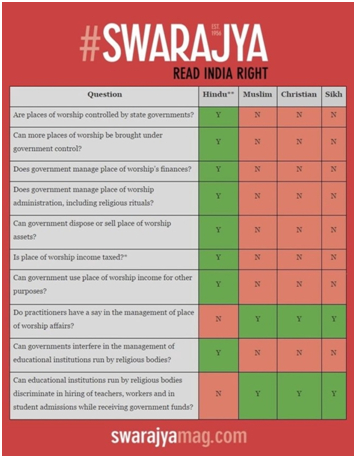
By law, Hindu temples come under state control, the state appoints the trustees, decides how to manage funds, and also taxes the income. Ridiculously enough, churches and mosques are exempted from such requirements. The state has no say in these matters. Below is a table from a Swarajya article I referenced above.


If this is not an explicitly anti-Hindu practice, I wonder what is. I would refer the interested reader to the other — more informed — sources I referenced above for details.

26/11, Malegaon And The RSS

Some events change the course of history. In India’s case, 26/11 was one such event. While the attack itself exposed Pakistan, thanks to Tukaram Omble, the police officer who was martyred catching Ajmal Kasab alive, the attack also derailed a much sinister plot by the UPA that was developing in the months leading up to 26/11. A few months before 26/11, there were bomb blasts in Malegaon for which Lt Col Prasad Purohit was arrested. Enough evidence is available in public domain suggesting that he was falsely implicated. One must add that the verdict is pending in the court.

However, what stands out is the alacrity with which the then essentially defunct Home Ministry acted in arresting Lt Col Purohit without evidence, and labelled it as Hindu terror. One must remember that in those days, India was witnessing literally a bomb blast every month. Facing the heat of rising Islamic terror and the looming election cycle, the prospects were looking ominous at one point. And so, out of thin air, Congress concocted the narrative of saffron terror about which a former bureaucrat R V S Mani has written in his book.

While this was before 26/11, Congress did not relent even in the face of such a gruesome terrorist attack. Just after 26/11 — despite Kasab’s arrest — Digvijay Singh released a book by one Aziz Burney titled 26/11 RSS ki Saazish, not once but twice.

Essentially, the Congress leadership was trying every trick under the sun — from falsely implicating Hindus in terror attacks to peddling conspiracy theories — to ensure that the charges of Hindu terror stuck. But truth has its way of revealing itself as the charges did not stick.

Congress supporters might say that many Muslims also, unfortunately, languish in jails for false terror charges. Therefore, they would argue, falsely implicating a person does not establish a larger conspiracy. There may be some merit in this defence, but not one incident comes to mind where a terrorist used Hinduism as a cause for carrying out a terror attack.

Therefore, it seems rather odd that the then ruling dispensation would explore a non-existent link as its first point of investigation in Malegaon, and eventually charge seemingly innocent Hindus to celebrate victory for unearthing ‘saffron terror’.

Due to space constraints, it is impossible to get into the details of several other incidents that merit some mention. For example, take the case of illegal Bangladeshi immigration in Assam. It is no secret that illegal Muslim immigration creates a permanent vote bank for the Congress. Pro-immigration parties worldwide endorse such policies for creating a support base.

However, the plight of displaced Kashmiri Pandits should have warned any government sympathetic to the Hindus of the disastrous consequences of changing demographics in a particular direction. And yet, for decades, the Congress actively encouraged such illegal Bangladeshi immigration. Today, in 14 out of 20 districts in Assam, Muslims are a majority.

As Prafulla Kumar Mahanta, the leader who signed the Assam Accord with the then prime minister Rajiv Gandhi said, Congress had several chances to implement the accord but it chose not to. He goes on to say that fundamentalists from across the border intend to turn North East into an Islamic country and there are ISI reports to this effect. The risk, he says, is that Assam may turn into another Kashmir.

This may be terrible news for the native Assamese. But, going by the Congress leadership, one wonders if they too want the same.

Then there are incidents like the inauguration of the Somnath Temple. It is well-known that Jawaharlal Nehru disliked the idea of Rajendra Prasad, the president of India, attending the inauguration of the restored Somnath Temple. In Nehru’s worldview, the president of a secular country should not attend a religious event. One can see merit in this principle. But, here was a civilisation that withstood a series of assaults for several centuries. Somnath Temple was a mark of the resilience, grit and character of this civilisation. That the prime minister should be opposed to the celebration of restoration of merely one temple amongst thousands that were destroyed by invaders reeks of inherent biases.
However, Nehru was far more magnanimous in his opposition, or his biases, than his progeny. But, what one gathers from this incident is that right from independence, the Congress party was unsympathetic to the revival of a subjugated civilisation.

Another case in point going back to the Nehru era is that of the assassination of Mahatma Gandhi. In 1948, after Gandhi’s murder, Vir Savarkar, a Hindutva icon, was arrested. To keep the story short, none other than Dr B R Ambedkar, law minister in Nehru’s cabinet, had a secret meeting with Nathuram Godse’s lawyer L B Bhopatkar to warn him that there was no evidence against Savarkar but that the cabinet was acting on the “whims of one man” to implicate him. That one man was none other than Nehru, according to Bhopatkar. (Ref: Manohar Malgonkar’s book The Men Who Killed Gandhi, Hindutva And Dr Ambedkar and Revealing Mahatma Gandhi's Murderer Nathuram Godse's Ties With RSS).
Of course, in some of the allegations above, sceptics would point to lack of ‘conclusive’ evidence. But, from state control of Hindu temples to RTE and Communal Violence Bill, from Kairana to Bodos, Congress’ sectarianism has systematically favoured minorities. Sonia Gandhi has wept when the terrorists were killed in the Batla House encounter but did not shed a tear for Lt Col Purohit. For every such charge, there is always some ‘explanation’.

One must remember, the art of winning civilisational battles lies in spotting early trends and acting on them. In a game of chess, the seeds of endgame are sown in the opening. But, once in the endgame, one cannot go back to the opening to reverse some blunders.

Unfortunately, time only runs in one direction — forward. Thankfully, there is every reason to be optimistic for we are course correcting.

Friday, May 17, 2019

An Open Letter To Mohan Bhagwat, Chief Of The RSS


 - May 13, 2019, 6:16 pm

Snapshot
·        Propagation of religions is a constitutional right offered to all in this country, including Hindus.
Reinvigorating Hinduism is the need of the hour.
Namaste Bhagwat ji,
As I write this, Delhi is voting in the sixth phase of this massive election, and hopefully we will all see Prime Minister Narendra Modi come back to power for another five years.
Many Hindus, including myself, take this election to bring back Modi as a “battle to protect the Hindu civilisation” from decline in the land of its birth.
Tens of millions of us had moist eyes when we saw Modi ji on TV take a dip in the Ganga and chant ‘mantras’ during the Kumbh Mela earlier this year. In the pursuit of ‘secularism’, the Indian state and its “elected heads forgot that they are inheritors of the thousands of years old Indian civilization” and that this nation bereft of its spiritual roots will simply be a lump of land, soul-less, bereft of its core values. They forgot that the foundation of this nation has been the Hindu values upon which have risen the world’s greatest faiths and religions, and have sustained peacefully, several others which entered from the West.
Finally, in Modi, we have a practising Hindu as an elected Prime Minister, not ashamed of demonstrating his Hinduness (and, on the contrary, proud of it). This has been rejuvenating.
However, I wish to draw your attention to a few issues, which will continue to tie the Hindu society down in a quandary, and prevent its reinvigoration even if Modi ji were to come back to power.
1 Articles 26 To 30 Of The Indian Constitution
a) Article 26 promises freedom to all religions in India to maintain institutions for charitable and religious purposes, and manage the affairs of their religion without interference of the state.
While Article 26 is being applied to all religious minorities in India in letter and spirit, Hindu religious institutions are being subject to endless interference from the Indian state. From “government appointees sitting on temple boards to interference in management of temple-owned lands”, Hindu Religious and Charitable Endowments (HRCE) Department and such acts implemented by nearly all state governments across India ensure “Hindus cannot spend the temple-money (hundi donations or land rentals) for promotion of their Dharma” and activities dependent upon successful running of templessuch as supporting small temples, build and maintain Veda pathshalas, orphanages and gaushalas. “Temples are the mainstay of Hindu Dharma. HRCE and such government departments are designed to debilitate Hindu Dharma.”
b) Article 30 guarantees all minorities that they will be free to establish and administer educational institutions without interference from the government, “even if they are funded by the government".
This means that Christian-run schools, with land allotted by the government, can have church prayers for all students, and Jamia Milia Islamia, a university ‘fully-funded by government of India’, can have a mosque inside the college campus and start each class session with invocation of Allah. Fair enough.
Shockingly, institutions run by the ‘majority Hindu community’, based on the limitations imposed by Article 28, “are not allowed to function according to their religious preferences”. This means that a Lingayat or Chinmaya Mission institution, with land allotted by the government, cannot be allowed to teach the wisdom of the Gita as part of its curriculum. The recent case against starting the morning invoking the Asato Ma Sadgamaya in Kendriya Vidyalayas is because of “this constitutional discrimination against the Hindus”.
Only an apartheid state discriminates against the majority. This must change. There are constitutional amendments to articles 26 to 30 recommended in the now lapsed Dr Satyapal Singh Private Member Bill. These must be adopted by the new government.
2. Foreign Funding Via FCRA Or Foreign Contribution (Regulation) Act
In 2016–17, 60 per cent of Rs 18,500 crore entered the country via organisations with explicit affiliations to international Christian missionary organisations, destined for Christian missionary organisations in India. This is in spite of the crackdown by the National Democratic Alliance (NDA) government on foreign-funded non-governmental organisations (NGOs). You will be shocked to learn that this money is only increasing each year.
Compare this influx of nearly Rs 11,000 crore for Christian missionary work, with Rs 550 crore that came in for Indic religious institutions — religious institutions run by Hindus, Sikhs, Buddhists and Jains, put together.
With the temple money not available to Hindus for protecting and spreading their religion, and on top of it this massive asymmetric influx of foreign funding for spreading Christianity, Hinduism is being killed slowly but surely. This must change.
#HinduCharter, a project started by Hindus from all over the country, demands that all 'institutional’ foreign-funding must be banned.
Only NRIs/OCIs/PIOs however, in their individual capacity, must be free to donate to Indian religious institutions including that of all minorities.
3. Muslim Population Explosion In India, And The Urgent Need For Large-Scale Ghar Wapsi
As societies around the world urbanise, they produce less and less children. In Europe, the US, Australia each couple is producing 1.3 to 1.8 children. The population replacement rate is 2.1 children per couple.
Hindus are producing 2.2 children per couple, barely at replacement rate. However, “the Muslim population in India is producing 3.4 children per couple including in rich and educated states such as Kerala”. This trend is no different from Muslims in Europe who are growing at similar rates.
If this is allowed to continue, then India is inevitably going to become a Muslim majority nation. Our liberals can continue to argue about whether it will take 50 years or 200 years. The demographic change of India will be inevitable.
Asking Hindus to produce more children or forcible birth-control of Muslim population of India are not practical solutions.
The only feasible solution is to call for large-scale ‘ghar wapsi’ of Indian Muslims. Millions of Muslims in India are aware of their Hindu roots and to date (proudly) retain references to their jatis in their names. Asking Muslims to feel proud of their Bharatiya roots and call them swadeshi Muslims is not good enough either.
Millions of Muslims in India will return to Hinduism if offered open platforms and processes for their shuddhi, and a way to return to their original jatis. Hinduism enables formation of new jatis if there is a lack of acceptance among any mainstream jatis. Marriages of their daughters, which is the biggest problem for returning Muslims, can be done within these multitude of newly-formed jatis.
Rashtriya Swayamsevak Sangh (RSS) is the only non-governmental organisation in the country capable of large-scale mobilisation of resources for enabling reconversion of Indian Muslims to Hinduism. No force. Only an open invitation and a formal institutionalised process of re-entry and support structure post such return. The RSS must set goals such as “10 per cent of Indian Muslims reconverted to Hinduism”.
After all, propagation of religion is a constitutional right offered to all religions in this country, including Hindus.
This is an urgent call of the hour. If the RSS does not open its arms to Muslims wanting to return to Hindu dharma, RSS as well as Hinduism will perish in the land of its birth. Even blaming RSS for not acting in time will not remain an option, for without Hindus, the memory and contribution of the RSS will be shoved into the dustbin of history.
Before I end, I must share with the readers of this letter what Dr Hedgewar had to say as the basis of forming the RSS:
The Hindu culture is the life-breath of Hindustan. It is therefore clear that if Hindustan is to be protected, we should first nourish the Hindu culture. If the Hindu culture perishes in Hindustan itself, and if the Hindu society ceases to exist, it will hardly be appropriate to refer to the mere geographical entity that remains as Hindustan. Mere geographical lumps don’t make a nation.
Mere geographical lumps don’t make a nation! A Muslim or Christian majority India will not remain India anymore.

Regards and pranam.

Standing Tall With The Kashmiri Pandits


 - May 13, 2019, 4:06 pm
A Kashmiri Pandit offers prayers during the annual Hindu festival at the Khirbhawani temple in the village of Tullamulla, east of Srinagar. 

Snapshot
·  The Modi government is the only hope for the rehabilitation and restoration of Kashmiri Pandit glory.
And it has begun well with the arrest of the genocide mastermind Yasin Malik.

Who killed Cock Robin could be an apt literary metaphor for the certain extinction that faces the Kashmiri Pandit community today. If there is one beacon of hope, it is Prime Minister Modi. Certain developments give some indications that if he is re-elected, it will be with a mandate to address the burning issues of the Kashmiri Pandits, specifically, and that of Kashmir generally.
The first noteworthy development which went unnoticed by political analysts is that in 2014, the BJP manifesto had merely stated that it would ‘facilitate the return of Kashmiri Pandits.’ This time, in 2019, the BJP manifesto states, ‘We will make all efforts to ensure the safe return of Kashmiri Pandits.’ This certainly sets the bar for a much higher level of accountability. By contrast, no other State party and even for that matter national parties such as the Congress cared to even mention the Kashmiri Pandit issue.
More interestingly is the much-delayed government action to arrest Yasin Malik and put him on trial in Jammu for cases against him and his murderous organisation, Jammu Kashmir Liberation Front. In the words of the Union Home Secretary, Rajiv Gauba, on 22 March 2019, ‘Murders of Kashmiri Pandits by JKLF in 1989 triggered their exodus from the Valley. Malik was the mastermind behind the purging of Kashmiri Pandits from the Kashmir Valley and is responsible for their genocide.’ It is good and long overdue that JKLF has been banned for being a terrorist organisation.
On 12 August 2016, Prime Minister Modi stated at an all-party meeting on Jammu and Kashmir, ‘It is also a fact that Kashmiri Pandits have been displaced from their centuries-old ancestral dwellings in Kashmir Valley. Such an atrocity against a particular community is the misdeed of terrorists trained and armed with weapons by Pakistan, and their sympathizers. These can never be the deeds of those who believe in “Kashmiriyat.”’
By 14 April 2019, the PM had upped his ante. In Kathua, he threw out a public challenge, ‘Will Congress ever be able to provide justice to Kashmiri Pandits? It is due to Congress' policies that my Kashmiri Pandit brothers and sisters had to leave their homes? The party and its allies witnessed the atrocities committed against Pandits but they paid no heed,” he said.
He was addressing an election rally in support of Union minister Jitendra Singh who was seeking re-election from Udhampur parliamentary constituency. Modi said that even today, the Congress was reluctant to speak on the issue of Pandits, but “this chowkidar is promise-bound to resettle them on their land. This process has already been started."
This is again a subtle but a strategic shift. Till now, Kashmir-centric policies have been about managing people towards predetermined outcomes through proxies who have commandeered public resources for great personal gains. This has not only alienated the people but also has not yielded the desired outcomes.
Managing processes is what a democratically elected government is mandated to do. These governance processes are the common ones dealing with security, stability and sustainability among others. Processes are housed inside and are driven by institutions. This is what has completely compromised and broken down in Kashmir.
The Prime Minister and his party seem to have identified what change in management process they want to institute. The first step in this process has to be to present it to the key stakeholders so that they can line up behind it. At the very top of this list of stakeholders is clearly the Kashmiri Pandit community. After all, it is their lives, their livelihood, their future that is at stake here.
Who within the community is the right party for the Prime Minister to engage with in a strategic dialogue? After all, as the rhyme Who killed Cock Robin warns us, all have fished in the troubled waters of Kashmir especially when it comes to the Kashmiri Pandits? And Kashmiri Pandits have their share of saints and their sinners, their collaborators and complicit compromisers.
Happily, there is a group that is eminently qualified, ready, willing and able. The Global Kashmiri Pandit Diaspora (GKPD) is a worldwide movement of Kashmiri Pandits which has been in existence for the last 10 years. It has interacted with policy makers at the highest level. Reflecting its own process culture, it conducted a grassroots campaign in Summer of 2018 which resulted in 35 organisations, representing virtually the entire community along with 15,000 signatories agreeing to a mandate.
The demands address the community’s core needs in the area of return, rehabilitation and restitution. This mandate was personally presented to Minister of Home Affairs, Rajnath Singh, in the Fall of 2018. GKPD has the representative legitimacy to deal with the Government of India on community matters and should be recognised as such.
Its members have a long track record of philanthropic support for the community which gives them credibility to get things done and, therefore, be seen as able to demonstrate their capacity to execute. GKPD’s operating style, based on transparency, contribution and collaboration, has made GKPD a trustworthy brand within the global Kashmiri Pandit community.
With one stroke of recognition of GKPD as representing the one voice, one demand of the community, Prime Minister Modi can signal his intent to get down to serious business.
The next step is to recognise that for the Government of India to negotiate with GKPD as the community’s representatives is the wrong way to proceed forward. Any people-centric approach will also create a people-centric reaction. There will be fierce opposition by those who would want the Kashmiri Pandits to become extinct. Again, it is the process driven framework that is the best practice answer here.
The Kashmiri Pandits situation fits all of the criteria governing Internally Displaced Persons (IDP). That is the framework which has to be customised to the situation here. This framework ensures that the KP issue does not become a political football but is dealt with in a manner that has legitimacy under international law. There is no need to reinvent the wheel when the global community has already come up with best practices dealing with such a tragedy and to which India is an official signatory.
Within the IDP framework, the number one priority is to work jointly on an imaginative confidence-building measure which is focused on rehabilitation measures. These cannot be token handouts which lead to second-class citizen status within J&K state and are not sustainable in the long term. Kashmiri Pandits are not lacking in courage or desire. For example, the news media has today covered the story of Roshanlal Mawa who was hit by four bullets in 1990 while returning to Kashmir.
But his attackers are still at large. In addition to a zero-tolerance policy against terrorists, there has to be a punitive policy against those who are threats to the miniscule Kashmiri Pandit minority in the Valley. This must be the foundation over which other measures can be overlaid. Kashmiri Pandits can be the poster children of a state empowering displaced people through skill training so that they can take their rightful place in society.
Again, GKPD has been running programmes in this sphere with infrastructure in place. The government need only provide the scale-up resources. A point of note is that the first and largest skilling university in India is run by a Kashmiri Pandit activist who can be co-opted in this mission.
The end game of the Kashmiri Pandits is to live in a secure, smart, sustainable area within their homeland in the Valley. A glide path can be formulated with milestones so that there is an understanding on how it will be affected. When this is initiated, then and only then can the Government of India take comfort that it has discharged its responsibility to its citizens in the state. Responsibility carries both components of responsiveness and ability within it. Prime Minister Modi can, therefore, demonstrate that what was lacking to date on both fronts has been rectified suitably.
When this goal is achieved, the Kashmiri Pandits can become stakeholders and partners in solving the Kashmir problem. After all, we have lived with it for 700 years and know the contours and the inside out of it. One way to understand the Kashmir problem is to once again examine the learnings from similar situations.
The most applicable is the famous Stanley Milgram experiments which were conducted at Yale University. The shocking results which defied what expert psychologists expected were that ordinary people would commit violent acts not because they were sadists or evil but because they were loath to disobey an authority figure’s directives.
People follow those who are perceived as having moral or legal authority. This response is ingrained in them in school, in the family and in political groups. Miller’s article on The Perils of Obedience laid out how people will go to any extremity from an autonomous state to an agentic state based on authoritative triggers and commit horrific acts.
What this suggests is that the Indian state has got it completely wrong. The milieu that needs to be created is that the cabal of religious political leaders in the state needs to be severely curbed even as the common man is given more freedom. This will take the oxygen out of the terrorists who today are glorified by Valley society. In a liberal democracy such as India, this has been difficult to execute but a way has to be found which is legal.
The panchayat empowerment initiative is a step in the right direction and no wonder the separatists hate it. Removal of Article 35-A should be an immediate priority. In my article in Swarajya on 14 August 2017 titled, “Explained – How The ‘Article 35-A Lawsuit’ Can Right a Historic Wrong in Jammu and Kashmir” I stated, ‘It will let new leaders with a liberating vision take the place of old Sheikhs, injecting fresh development within the state.’
Finally, the Government of India should examine the merits and demerits of the Kashmiri Pandit community’s desire to take Pakistan to task in international venues for being the key instigator of the genocide of Pandits. Rhetoric by Prime Minister Modi on naming and shaming Pakistan is necessary but not sufficient. While Prime Minister Modi should be commended for his firm stance and eventual success in getting Masood Azhar declared a global terrorist, the difficulties in doing so highlight the challenges in applying the terrorist framework to reform Pakistan. And there will be no shortage of Masood Azhars as history shows.
By contrast, a judgement against Pakistan for aiding and abetting the genocide of Kashmiri Pandits will have teeth and claws to it. The Government of India can cooperate with the Kashmiri Pandit diaspora in providing the information that will nail Pakistan’s complicity. The Government of India has nothing to fear here. It does not violate its dictum that India does not want international interference. It is the civil community which will act.
When one looks at ethnic cleansing data, the genocide conclusion is inescapable. The Kashmiri Pandits were given 48 hours’ notice to leave the Valley. The community was completely cleansed, 450,000 had to flee under enormous duress with loss of life, limb and assets. As many as 1,397 Kashmiri Pandits and other non-Muslims who were killed have been identified to the individual level and more names are being added, a painstaking and painful exercise.
Srinagar was the number one locality but Varahamulla and Anantnag and Kupwara followed in their count. What is shocking is that the number of locations they were killed in which is in the hundreds, demonstrating the reach and spread of the theofascist command and control system that is in place. There were 1,403 Hindu religious places, 975 temples and 428 cremation grounds. Out of these, 347 have been desecrated or destroyed, and 217 dharmshalas destroyed. Others have been taken over or the land encroached. All revenue records have been suppressed or falsified.
The Kashmiri Pandits know their truth. It has served them well and they will never compromise on it. This truth cannot be subverted and is only growing stronger with time as the community spreads its wings around the globe.
Their hand of partnership is extended to Prime Minister Modi to craft win-win outcomes based on robust processes which are instituted by him. A predecessor BJP leader at the very top of the governance hierarchy told me a decade ago in New York, ‘Mr. Kaul, what happens to Kashmiri Pandits will be the litmus test of the idea of India.’
The idea of India should be an inspiring India where every Indian stands tall. As a winner and not a victim.

Selective Data On Communal Violence In India: IndiaSpend, English Media Have A Lot To Answer For

https://swarajyamag.com/ideas/selective-data-on-communal-violence-in-india-indiaspend-english-media-has-a-lot-to-answer-for by   Swa...