Monday, April 29, 2019

BJP plays the long game: Reclaiming the ‘Idea of India’ for the next century

https://timesofindia.indiatimes.com/blogs/voices/bjp-plays-the-long-game-reclaiming-the-idea-of-india-for-the-next-century/

April 29, 2019, 1:07 PM IST 

At the best of times, Indian parliamentary elections are chaotic and transactional affairs. Disguised under a thin veneer of ideology, political parties mobilize sub-group identities to capture the resources of an ever-expanding state in an environment of general scarcity. Political ideologies converge once elections conclude, and state resources are then used to perpetuate networks of patronage to retain power in subsequent elections. Amidst the parade of politicians of modern India, only a few have ever sought to conduct themselves otherwise; fewer still have achieved it. Ideology is the first casualty of India’s politics.
2019 is different. Beneath the viciousness and the cacophony about personalities and dynasties, an ideological battle is being fought on three existentially important issues confronting modern India: cultural identity, national security and the economy. On all three issues, substantive clarity and differentiation have now emerged between the positions of the BJP and the Congress. Rarely has the messaging of the two contenders been more sharply defined, or the choice between the two more stark.
In 2014, BJP’s leadership seemed unsure about the degree to which they could – or should – embrace their historical platform of Article 370, 35A, Ram Janmbhoomi etc. The issue of UPA’s decade of corrupt reign remained front and centre. In 2019, this has changed. While they were never unsure about the righteousness of their cause even during decades on the margins, deep confidence has now emerged in BJP’s leadership team of Modi-Shah-Jaitley about the achievability of their purpose.
The BJP and the RSS are no longer insecure about being perceived as interlopers in New Delhi. Indeed, they are the ‘establishment’. Now, Modi speaks calmly and surefootedly about BJP’s core platform. He is setting the agenda, confronting the Congress and all regional parties, and demanding that all political parties clarify their positions rather than lurk in ambiguity.
This is a fundamental change in approach that has happened for two reasons. First, if the true wages of power is confidence, the BJP’s dominance of India’s political landscape over the last five years has allowed it to earn it in abundance. This has given the BJP leadership the courage to execute upon the lessons of the second observation, the directional reality of which has been best recognized by Arun Jaitley, modern India’s foremost political strategist: At the point of convergence of India’s evolving political-economy and shifting demographics lies a young, aspirational middle class which will soon become a billion in size, and this electorate will possess right-of-centre positions which are in-sync with that of the BJP on the three core issues of national identity, national security and a liberal market economy.
As such, the key question of 2019 (and for the next several decades) will be as follows: Who will best address the hopes and fears of a billion-strong aspirational middle-class with subaltern origins from India’s countryside. This is an electorate that will have no memory of seminal Indian dates such as 1947 or 1975, or even of 1984 or 2001. They will have little affinity with Nehru’s vision of an anglicized soft-state governed by early-20th century European romanticism. And, they will oppose the hagiography surrounding the then urban Indian elite who negotiated their way into post-1947 power behind closed doors. Most of all, they will resent the petty-dynasties who populate the Congress leadership and have governed India contemptuously ever since.
This new electorate will demand economic security, historical dignity and national pride. And as their levels of affluence rise, exposure to the world and technology will allow them to make the journey up Maslow’s pyramid of needs with great speed.
In that journey, their needs will evolve: They’ll start with clamouring for economic freedom and a market-based economy as the only organizing principle that can deliver them jobs and wealth. They will insist on reclaiming India’s historical role as one of the key centres of civilization for the world, and for it to have the capacity to project force globally to protect its national interests. And, they will demand that India’s cultural definition of itself be restored to an unsaid (and potentially indescribable) Vedic historicism thousands of years in the making, and which is the core constituent of the making of every Indian’s worldview irrespective of their religion.
The sociological evidence for such shift in political sentiment is best seen next door in China, and which is, ironically, the only other civilization-as-nation managing similar issues: the rise of a young, proud, and nationalist middle-class in China. Just as the new Chinese middle-class has not followed the expected trajectory of demanding greater social freedoms along with their rising incomes, the new Indian subaltern middle-class will not seek to define modernity along the lines of Western individualism but alongside historical and uninterrupted Indian traditions of social organization. (Thin anecdotal evidence is already arising, for example in the way the new Indian middle-class is more likely to seek marriage as per the very Indian practice of ‘arranged marriages’ where families lead such search, rather than the expected individualism that is the norm in the West.)
They will be, in short, an electorate tailormade to receive the RSS’ and BJP’ messaging. For almost a century, the RSS (and then the BJP) have been consistent about articulating a message of cultural reformation and right-of-centre economic policy. It is to their good fortune that their message will achieve deliverance at the hands of this new India.
The BJP is playing the long game. While the Congress is yet to come up with a coherent issue for 2019, Modi’s three-issue platform is setting the BJP up for a golden period of electoral dominance that could last for decades to come.
What are the three core issues of 2019, and of the new electorate?
Cultural reformation and national identity:
The BJP has made ‘culture’ and ‘national identity’ as core issues of the 2019 campaign. This is a vast and complicated subject, including severely contested anthropological issues of nationhood, religion and citizenship. This ideological position informs the positions not only of Article 370, 35A, the Citizenship Bill, Ram Janmbhoomi … but also, core foundational issues that involve the very definition of what it means to be Indian: Hindutva.
Barring the echo-chambers of the academy and the media, the general mood of the new electorate has already begun to shift and to support BJP’s view of the world. This will only accelerate along with the increase in the size of the new electorate, forcing even all political parties to adjust themselves to adjust to the BJP’s point of view. The clearest evidence is the manner in which the Congress leadership has felt compelled to make overt displays of their religiosity, something that was inconceivable for previous generations of the party’s leadership. While the Congress’ actions could be mere election tactics, this could not have happened if they did not themselves sense a major shift in the sensibilities of the nation.
In many ways then, the resolution of India’s culture and identity issues can only happen in the coming decades when both, the new electorate has become large enough in order to allow politicians to adjust themselves accordingly, and, a new political vocabulary has been created and accepted. In 2019, it is not possible to carry forward meaningful debates on any contested national issues using the tired vocabulary of the past. Over the last few decades, the attempts to explain complex thoughts in one-word summaries (say, Hindutva) has been unsuccessful for the BJP. Instead, its use unleashes a torrent of pre-configured constructs on each side, immediately ending prospects of advancing the discussion rationally.
It is the creation of this new vocabulary that will be a challenge (and an opportunity) for the BJP in the coming years. An entirely new language that can calmly explain the relationship between India’s Vedic birth and an inclusive present for all Indians in the 21st century, and which can be explained to a new electorate unburdened by history or by the coded language of contemporary India.
In doing so, the BJP may have a chance to finally heal both, the open wound of India’s partition, and the subconscious anger of a people for the centuries of assault on their Vedic civilization’s living fabric. It is self-evident that this reconciliation cannot be achieved with the violence that some fringe elements of the BJP have displayed in the last five years, but graciously and confidently so that the course of the nation can be set differently. Just like it can only be the BJP who can organize peace with Pakistan, it can only be the BJP which can reorder the debate around culture and identity for the next century.
For more than a thousand years before the birth of Christ, India’s tremendous agricultural surpluses allowed it to create a complex Vedic civilization with a daring understanding of life and consciousness. For a thousand years after, India was the civilizing force for many parts of the world. India peacefully gave its commerce, mythology, tenets of law and administrative organization, religion, language etc. to the Indianized states of Asia and beyond. (George Coedes has published a remarkable work of scholarship on this subject.)
The BJP would do well to tap into India’s overall economic growth and rising cultural confidence to reclaim and redefine the ‘idea of India’ for the next century by addressing the following three issues plainly and calmly.
National security and India’s engagement with the world:
As a matter of some irony, a hundred years from now, historians will remember Modi’s greatest legacy to be the creation of a new foreign policy doctrine for India rather than the culture wars which gave him his initial rise. Alone amongst the Prime Ministers who have preceded him, Modi has shown the capability to play the bold, long game.
While keeping one eye on the neighbourhood, he has sought to reengage with the world in a markedly different manner than previous governments. Modi has shown both, a willingness to create a calibrated response to Chinese actions when prompted, and – equally importantly – the ability to scale down tensions when needed. He has sought to deepen the relationship with new allies as a first step towards enhancing strategic options but realized that old relationships are important. He has shown the willingness to take the battle to the other’s backyard, and yet, not present India as easy to provoke. (In this, the new electorate will pose a challenge: newly-affluent sub-population groups are always hyper-nationalist and easy to inflame, and the BJP needs to be able to rein-in its fringes.)
All of this is coalescing into a nascent, yet undeclared ‘Modi Doctrine,’ and which will focus in-time not on Pakistan, but on India’s two most important foreign policy relationships: the US and China. As India joins them in the club of the three largest global economies, India must engage deeply with both to articulate each’s expectations of the other, and to participate more fully in the reordering of the global order.
India’s relationship with each is unique, and yet, the three are tied together via an evolving US-led Indo-Pacific strategy whose scope and manifestation is yet to fully unfold. India would do well to avoid the incessant posturing and hesitation of its past and move forward to protects its interests wherever such allegiances may lie.
But between the two, it is the relationship with China that will soon become the fulcrum of Indian foreign interest. For a thousand years predating the Islamic invasions of India, China and India fought quietly and fiercely for dominance of Asia with competing ideas of philosophy, civilization, law, administration and religion. In the annals of history, the length of such rivalry probably exceeds that of any other two nations. Indeed, the pre-medieval ‘great game’ was the fight between the equally powerful and rich civilizations of India and China for influence in Asia, the evidence of which now lies scattered across South East Asia in its ruins, its culture and its religious sub-structure.
India’s foreign policy apparatus is hopelessly ill-equipped as of now, with insufficient diplomats and an equally insufficient ambition. Over the next five years, Modi must build the scaffolding within which a $10 trillion economy (and in time, a $20 trillion economy) can protect its foreign policy interests for the next hundred years. Its endgame: friends should admire it; adversaries should respect it and enemies should fear it.
The BJP has rightly made national security the central subject of the 2019 elections: The state’s primary duty is to exercise its monopoly on the use of force to provide law-and-order at home and security at the border. To make up for decades of neglect during which India has lost the respect of its neighbours and made few new allies, Modi must document his foreign policy doctrine, and propose, without reservation or delay, that India seeks global partners who represent common values, common long-term interests, and a framework within which India can operate as an equal partner to protect common interests.
The end of the administrative state:
Modern India continues to suffer from a socialist worldview first laid by Jawaharlal Nehru, and on which Indira Gandhi built a ruthless and expansive ‘administrative state’. This ‘administrative state’ has functioned as an invisible state-within-a-state, and is comprised of an enabling framework of sprawling state-owned companies and state-led institutions; year-after-year, it does a bewilderingly efficient job of destroying national wealth.
This is the nerve centre of India’s problems: Unless the BJP dismantles this superstructure, all else is bound to fail. Without economic strength, grand national ambition is mere posturing.
Modi threatened to demolish the administrative state in his run up to 2014. But the last five years have left scope for a much deeper resolve for 2019-2024. Case in point: In 1951, the number of government-owned public sector units was five. By 1984, Indira Gandhi had made that 220. Surprisingly, even the BJP increased the number from 290 in 2014 to about 340 in 2018. (Numbers sourced from Prannoy Roy’s well-researched recent book, “The Verdict.”)
Modi risks falling into the trap common to all earnest leaders: the belief that they’re different because they’re personally honest, and that with sincere effort, they can manage the economy. That’s wrong. The modern economy is unimaginably complex. It cannot be comprehensively understood, let alone be effectively managed, and certainly never by the very state-institutions and bureaucracy that have been at the centre of its despair. Modi’s increasing attempts to do so reflect his gradual embrace of the administrative state as the tool through which he seeks to deliver the promised reforms, ignoring the reality that both forces are actively opposed to each other.
At stake is not only the reform process but the moral arc of India and the long-suffering soul of the average Indian, corrupted through decades of bending to the whims of the administrative state. Modi and Jaitley understand, a few other Indian politicians, that economics is not about mere budgets or numbers; it is a moral philosophy, requiring of each citizen a framework around which they make individual choices.
As such, reform must begin where the decline began: The government ownership of banks and enterprises. Everything else is mere tinkering. Modi-Jaitley must establish a target so bold that its execution can launch a multi-decadal period of double-digit GDP growth which will end, once-and-for-all, not only the curse of poverty, but also, India’s second-tier status amongst great nations.
When faced with forces one doesn’t understand, it is expedient to revert to a known vocabulary of Indian politics: Secularism, polarization, Hindutva, nationalism etc. This is understandable; language allows us to make sense of the known world, and to share such comprehension using a shared platform of understanding.
But language is also a weapon. In the hands of the Indian politician, language is used to ambush those who think differently. For the new India that will emerge with this new electorate, the BJP may need a different set of words altogether so as to create, without arrogance or anger, what George Kennan wrote of as the “placid give and take …, in particular: The tempering of all enmity and all intimacy, the balancing function of personal self-respect, the free play of opposing interests.”
Through long years of internal perseverance (and some demographic manna), BJP now finds itself in an enviable situation: An ability to shape the nation for the next century as it had long promised it would. If now it were to fail to act decisively, it would only have itself to blame.
(The author can be reached at annatjain@gmail.com)
Annat Jain is the founder of Acropolis Capital Group, an investment firm investing in India.

Saturday, April 13, 2019

LOYAL DESCENDANTS – PART 1

https://shwetankspad.com/2016/03/14/loyal-descendants/

Mar 14, 2016


There is a mind-boggling web of interconnectedness that relates one journalist-historian-writer-politician-bureaucrat with another journalist-historian-writer-politician-bureaucrat.

Almost every high-profile person in the Congress-Communist establishment related to each other whether it is in politics or bureaucracy or journalism. Recent books by Kuldip Nayar, Tavleen Singh, and Sanjaya Baru also tells the same. Here is one set of sample:

THE THAPARS:

Remember the brutal Jaliyanwallah Bagh massacre, the monstrous act of General Dyer? Even the arch-imperialist Winston Churchill condemned it as a “monstrous event, an event which stood in singular and sinister isolation”.

General Reginald Dyer and his actions were backed by Punjab Governor Sir Michael O’Dwyer and the colonial government of India headed by Lord Chelmsford. Not a surprise.

But, General Dyer and Michael O’Dwyer (who was subsequently shot by Udham Singh) had admirers in India as well. The prominent name in the list was none other than Dewan Bahadur Kunj Behari Thapar of Lahore. In fact, the Golden Temple management (the predecessor of the SGPC) presented Dyer a Kirpan (sword) and a Siropa (turban) along with Rs. 1.75 Lakhs contributed by Kunj Bihari Thapar, Umar Hayat Khan, Chaudhary Gajjan Singh and Rai Bahadur Lal Chand. (Report).

Thapar’s family was newly wealthy, having made their fortune in trade during the first world war, as commission agents for the colonial British Indian Army. Kunj Behari Thapar did everything necessary to please his colonial masters to keep his hold in the British Indian Army. For loyalty during Jallianwala crisis, Kunj Behari Thapar was awarded the Most Excellent Order of the British Empire in 1920. (Copy of the Edinburgh Gazette).

Kunj Behari Thapar had 3 sons 1) Daya Ram Thapar, 2) Prem Nath Thapar and 3) Pran Nath Thapar and 5 daughters.

1) Daya Ram Thapar: Daya Ram Thapar worked in the Military Medical Services of India with the influence of his father and retired as Director General of Indian Armed Forces Medical Services. He has a son Romesh Thapar and two daughters Bimla Thapar and Romila Thapar.

Romesh

Romesh Thapar: Born in Lahore, Romesh Thapar was therefore sent to England for his education. Starting as a fashionable socialist, Thapar developed into a Marxist ideologue over the years, and remained a member of the Communist Party of India (Marxist) until his death.

Romesh Thapar started Seminar, as a monthly journal, and established a stable revenue model predictably, nearly all the advertising revenue comes from the government, and a large proportion of the sales are also to government institutions and libraries. Thapar also shifted base to Delhi from Mumbai in order to leverage their growing political clout in the socialist and “socially progressive” Nehru-led dispensation. They were duly allotted prime property at a low rate by the government.

Thapar and his wife grew especially close to Indira Gandhi through the 1960s and 1970s. Although he had known her earlier, it was after Nehru’s death that Thapar became a part of the inner circle of then Prime Minister Indira Gandhi. This connection brought Thapar significant clout in society and government, and numerous sinecures were showered on him as patronage. Thapar served at various times as director of the India International Centre, of the National Books Development Board, of the ITDC, and as vice-chairperson of the National Bal Bhavan, Delhi, all of which are government sinecures conferred on him by successive Congress Party governments.

Romila Thapar

Romila Thapar: A famous “top” typical JNU Nehruvian communist ideologue historian, who gets to  write our textbooks and pollute them with pro-Congress Marxist  propaganda. Thapar’s appointment to the Library of Congress’s Kluge Chair in 2003 was opposed in an online petition bearing more than 2,000 signatures, on the grounds that she was a “Marxist and anti-Hindu”. The Communist Party of India (Marxist) supported her appointment by calling her “a liberal with a scientific outlook”. To Know more about the great historian, you may check this piece: (Eminent Historian’s continuing fraud)

2) Pran Nath Thapar: General Pran Nath Thapar was the youngest son of Diwan Bahadur Kunj Behari Thapar of Lahore. In March 1936, Thapar married Bimla Bashiram Sehgal, sister of Gautam Sahgal, whose wife Nayantara Sahgal (recently famed for her award wapasi) was a daughter of Vijayalaxmi Pandit and niece of Jawahar Lal Nehru.

Pran Nath Thapar

Gen. Pran Nath Thapar was the only Indian Army Chief to have lost a war (Against China in 1962). However, on his retirement, Gen. K.S. Thimayya recommended Lt. Gen. S. P. P. Thorat as his successor, was however overruled and Pran Nath Thapar was selected. It’s amazing how Pran Nath Thapar’s role in 1962 debacle is left out of history books. Anyway, he was forced to and resigned in disgrace after the debacle.

General Thapar and Smt. Bimla Thapar had four children, of whom the youngest is the prominent journalist Karan Thapar.

Karan Thapar

Karan Thapar: A famous media personality who also  writes columns frequently for Hindustan Times. The Nehru family itself is related, through blood  and marriages, to the high-profile Thapar family. To know more about his journalism, you may refer this piece: (Karan Thapar‘s advice to Narendra Modi)

THE SINGHS:

Son of Sujan Singh of village Hudali in Khushab, Shahpur District (Now Pakistan), Sobha Singh was a witness in the assembly bomb explosion incident on April 8, 1929. He identified Bhagat Singh and Batukeshwar Dutt and subsequently on Sobha Singh’s testimony, Bhagat Singh, Sukhdev and Rajguru were sent to gallows.

Sobha Singh

Sujan Singh & Sobha Singh were accepted as senior-grade contractors and building contracts of Lutyen’s Delhi were being given out to them when Hardinge, the Viceroy of India, announced the plan to move the British Indian Capital City to Delhi. For the South Block, and War Memorial Arch (now India Gate), the uneducated Sobha Singh was the sole builder. Sobha Singh bought as much land in Delhi as he could. He bought several extensive sites at as little as Rs 2 per square yard, freehold. There were few other takers, and he came to be described as adhi dilli da malik (the owner of half of Delhi). He was knighted in the 1944 Birthday Honors. The younger brother of Sir Sobha Singh, Sardar Ujjal Singh later became a parliamentarian, and also Governor of Tamil Nadu.

Sir Sobha had four sons: Bhagwant Singh, Khushwant Singh (prominent journalist, and author), Major Gurbakash and Daljit, and a daughter,  Mohinder Kaur.

KhushwantSingh

Khushwant Singh was a vocal Indira Gandhi supporter and known to be the most open Emergency apologist. Sir Sobha’s daughter Mohinder Kaur is known for being accommodative with her daughter-in-law Rukhsana Sultana, wife of son and Army Officer, Shivendar Singh. Rukhsana was famous for being a close friend and accomplice of Sanjay Gandhi during the emergency and also later known for being the mother of actress, Amrita Singh.

Malvika

Khushwant Singh’s son Rahul Singh can easily be found on NDTV or some other news channels defending the serious sexual/criminal offenders, the likes of Tarun Tejpal, Testa Setalwad and R.K. Pachauri.

It is indeed interesting that grand-daughter of Kunj Behari Thapar (Jaliyanwallah Bagh massacre apologist), Malvika Singh  married Tejbir Singh the grandson of Sir Sobha Singh whose testimony sent Bhagat Singh, Sukhdev, and Rajguru to gallows. Some reunion this.

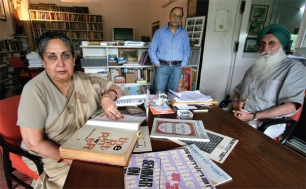
The circuit of loyal descendants completes and running in the name of SEMINAR Magazine. Started by Romesh Thapar, Seminar continues to be published from Delhi, brought out by Thapar’s daughter Malavika Singh and her husband Tejbir Singh and is a LOYAL platform for the Congress ecosystem.

To know about more, here is the link to one of its issues of Seminar.


It’s a common ploy among the liberal chatting class to hound their Hindu interlocutors as intellectual descendants of Godse. The Late Khushwant Singh, Romesh Thapar, Romila Thapar and now Tejbir and Malvika Singh along with Karan Thapar used this insinuation effectively. Someone must tell them – We may or may not be intellectuals, but you are direct descendants of the British collaborator Dewan Kunj Behari Thapar and Sir Sobha Singh and still enjoying the lifestyle on money earned by betraying India and as being an accomplice to the Congress’s brazen corruption.

Thursday, April 11, 2019

Manifesto Blueprint to 'New India' with Strong Cultural and Traditional Roots, Says BJP

https://www.news18.com/news/politics/manifesto-blueprint-to-new-india-with-strong-cultural-and-traditional-roots-says-bjp-2093629.html

The BJP in its manifesto promises to build a New India that takes from its rich culture and said that it would 'invest in strengthening our cultural roots and preserving civilizational continuity'.

Updated:April 8, 2019
Edited by: Zoya Mateen

New Delhi: In the BJP Manifesto, Sankalp Patra released on Monday, the ruling government proclaimed that its philosophy as a party is anchored to the civilisation ethos of India. To highlight this claim, the BJP promised to build a New India that takes from its rich culture and said that it would “invest in strengthening our cultural roots and preserving civilisation continuity”.

“Far from seeing our cultural values as hurdles to progress, we see them as essential ingredients of our future,” the manifesto read.

Apart from reiterating their stand on the Ram Mandir, the Sabrimala temple and Uniform Civil Code, the party manifesto announced policies aimed at promoting ancient India's traditions such as Yoga and the Sanskrit language. “We will ensure that the teaching of Sanskrit is expanded and popularized at the school level. We will also provide 100 Panini fellowships to researchers and scholars across India to promote research in Sanskrit,” BJP said in its manifesto.
BJP said it will also constitute a National Task Force to study the status of all written and spoken languages and dialects in India.

To increase accessibility and promote all culturally and historically significant heritage sites and museums in India, it will launch a web-enabled virtual tour of all such locations through ‘Dharohar Dharshan-an integrated web portal’. This will eliminate the obstacle of geographical boundaries, and provide real-time experience of Indian cultural heritage, accessible from any corner of the globe, the party claimed.

The government is credited with promoting Yoga globally, and in the manifesto BJP said it will continue to make efforts at doing so. As of now, June 21 is celebrated as the International Yoga Day. “We will promote Yoga as a vital method to achieve physical wellness and spiritual rejuvenation across the globe and will continue to work towards training of Yoga practitioners,” BJP manifesto stated. They have also promised to have a rapid expansion of Yoga health hubs, Yoga tourism and research in Yoga.

Apart from this, an International Cultural Festival will be organized on a grand scale every year in 5 different states to showcase and promote the rich diversity of Indian culture and efforts will be made to ensure greater participation of Pravasi Bharatiya population, along with the international community.

The party also promised that it will invest more in its earlier schemes, the Pilgrimage Rejuvenation and the Spirituality Augmentation Drive (PRASAD) by the Ministry of Tourism that look after the conservation of heritage sites. “We are committed to conserve and promote all culturally, religiously and spiritually significant heritage sites related to every faith in India,” the manifesto read.

In 2015 twelve cities namely Amaravati (Andhra Pradesh), Gaya (Bihar), Dwarak a(Gujarat), Amritsar (Punjab), Ajmer (Rajasthan), Kanchipuram (Tamil Nadu), Vellankani (Tamil Nadu), Puri (Odisha), Varanasi (Uttar Prasesh), Mathura (Uttar Pradesh), Kedarnath (Uttarakhand) and Kamakhya (Assam) were identified for development under this scheme.

BJP also said that it is commiteed to the preservation of the Ganga River and will ensure the clean and uninterrupted flow ofthe river water from Gangotri to Ganga Sagar. The manifesto said that it we will ensure that the sewerage infrastructure to deal with 100% of the waste water from Ganga towns is completed and is functioning effectively, and will take steps to enhance the river flow. “The villages located on the banks of the river, which are already open defecation free, will be taken up under a special project to ensure complete sustainable management of solid and liquid waste,” the manifesto read.

Tuesday, April 9, 2019

Political reforms are far more urgent than the economic kind

https://www.livemint.com/opinion/columns/opinion-political-reforms-are-far-more-urgent-than-the-economic-kind-1554233034202.html

03 Apr 2019
R. Jagannathan

The country should decentralize power and fix its justice and electoral systems as its top priority

Assorted pundits, public intellectuals and economists are wringing their hands in despair over the declining quality of political debate in the run-up to the 2019 elections. They additionally fret about the ability of the exchequerto fund the largesse being promised by various parties to voters. But the hand-wringing is pointless when we fail to see what needs fixing: we have a broken state, and elections are really about how to capture power for the benefit of a chosen few. And when the state is broken, markets will be commandeered to serve the interests of those who fund politicians. So, before we talk of economic or any other reform, we need to fix the state.
The Chanakya sutra is a useful source of wisdom in this regard. The first four segments of it are particularly relevant and instructive. They read: Sukhasya moolam dharmah; Dharmasya moolam arthah; arthasya moolam rajyam; rajyasya moolam indriyajayah (happiness is based on upholding dharmadharma is based on wealth and economic health; wealth is based on the state; and the state’s stability depends on control of the senses).
This may sound quaint in today’s world, but if one adjusts for the kind of society and economic and political structures that prevailed in Chanakya’s time, a common sense rendering of the sutra today would read something like this: “The well-being of the people depends on upholding a just social order (note: dharma is not religion in this context); order depends on wealth and productive economic activity; economic activity depends on a strong and limited state; and a strong state needs strong institutions so that it does not act arbitrarily or whimsically."
Note that artha (wealth) is only one small part of the sutra. It is a necessary condition for a state and its people to be happy, but not a sufficient one in itself. This implies that there are more things we need to fix than just our economy.
In his recent book, The Third Pillar, former RBI governor Raghuram Rajan contends that the state and markets (the other two pillars) have grown more powerful while the community pillar has weakened in the West. In our case, we have not fixed the basics of the state and markets, and our electoral impulses allow small groups or communities to capture and suborn the state for narrow ends. Fixing this skew means non-economic reforms must be given greater priority in our scheme of things than mere economic reforms. Non-economic institutions need greater independence than a Reserve Bank here or a Competition Commission there. Here are three key areas for political and constitutional reform that may need to precede greater economic reform.
1. The first thing we need to fix is law and order, maintaining which is a state’s primary duty to citizens. This means not only the police and the criminal justice system, but also the judiciary. If the entire system is not insulated from political control, we are not going to have any rule of law. Judicial independence does not mean judges appointing themselves; that too is a perversion. This change can only happen through legislation to strengthen existing institutions (or create new ones) by insulating them from political influences.
2. We also need greater devolution of power from the centre to states, and from states to local bodies. India’s Constitution is a mess of conflicting provisions, including a concurrent list where both the centre and state can legislate. As politics has become more regional, some political and economic power has indeed shifted to states, but cities are still powerless to design their own future. We need to scrap the concurrent list, and devolve more economic power to the lowest possible political levels. If a third front ever comes to power in Delhi, it does not matter if its constituents have no common policy. One common thread that should unite them is the need for big constitutional changes than devolve power away from Delhi. Some 1.36 billion people can’t be governed effectively from Delhi; and several million cannot be ruled from state capitals.
3. Electoral reform is the last of the most important non-economic reforms we need to think about. This includes state funding of candidates, bringing transparency to political party funding, and reworking constituencies so that all constituencies are roughly the same size. The electoral bonds scheme for funding political parties with “white" money does nothing to really clean up the swamp of corrupt money that seeks to influence policies.
Our state-wise Lok Sabha seat allocations are based on population figures from the 1970s. We thus give greater representation to the southern states, and less to the populous ones in the north. The logical way to rework this is to give more Lok Sabha seats to the more populous states, and compensate the states which lose out with a higher quota of Rajya Sabha seats, so that they have more blocking power in the Upper House. No democracy can be sustained if the value of one vote in Uttar Pradesh is far less than one vote in the south.
The state needs fixing in many ways, but the above three are crucial. We need political and constitutional reforms more than just economic reforms. Once the former happen, others will follow.
R. Jagannathan is editorial director, ‘Swarajya’ magazine.

Sunday, April 7, 2019

Why America Needs New Alliances

https://www.wsj.com/articles/why-america-needs-new-alliances-11554503421

The international order of the Cold War era no longer makes sense. But the world can’t do without U.S. leadership. Here’s a better approach.
By 
Yoram Hazony and Ofir Haivry
April 5, 2019

President Trump is often accused of creating a needless rift with America’s European allies. The secretary-general of the North Atlantic Treaty Organization, Jens Stoltenberg, expressed a different view Thursday when he told a joint session of Congress: “Allies must spend more on defense—this has been the clear message from President Trump, and this message is having a real impact.”
Mr. Stoltenberg’s remarks reflect a growing recognition that strategic and economic realities demand a drastic change in the way the U.S. conducts foreign policy. The unwanted cracks in the Atlantic alliance are primarily a consequence of European leaders, especially in Germany and France, wishing to continue living in a world that no longer exists. The U.S. cannot serve as the enforcer for the Europeans’ beloved “rules-based international order” any more. Even in the 1990s, it was doubtful the U.S. could indefinitely guarantee the security of all nations, paying for George H.W. Bush’s “new world order” principally with American soldiers’ lives and American taxpayers’ dollars.
Today a $22 trillion national debt and the voting public’s indifference to the dreams of world-wide liberal empire have depleted Washington’s ability to wage pricey foreign wars. At a time of escalating troubles at home, America’s estimated 800 overseas bases in 80 countries are coming to look like a bizarre misallocation of resources. And the U.S. is politically fragmented to an extent unseen in living memory, with uncertain implications in the event of a major war.
This explains why the U.S. has not sent massive, Iraq-style expeditionary forces to defend Ukraine’s integrity or impose order in Syria. If there’s trouble on Estonia’s border with Russia, would the U.S. have the will to deploy tens of thousands of soldiers on an indefinite mission 85 miles from St. Petersburg? Although Estonia joined NATO in 2004, the certainties of 15 years ago have broken down.
On paper, America has defense alliances with dozens of countries. But these are the ghosts of a rivalry with the Soviet Union that ended three decades ago, or the result of often reckless policies adopted after 9/11. These so-called allies include Turkey and Pakistan, which share neither America’s values nor its interests, and cooperate with the U.S. only when it serves their purposes. Other “allies” refuse to develop a significant capacity for self-defense, and are thus more accurately regarded as American dependencies or protectorates.
Liberal internationalists are right about one thing, however: America cannot simply turn its back on the world. Pearl Harbor and 9/11 demonstrated that the U.S. can and will be targeted on its own soil. An American strategic posture aimed at minimizing the danger from rival powers needs to focus on deterring Russia and China from wars of expansion; weakening China relative to the U.S. and thereby preventing it from attaining dominance over the world economy; and keeping smaller hostile powers such as North Korea and Iran from obtaining the capacity to attack America or other democracies.
To attain these goals, the U.S. will need a new strategy that is far less costly than anything previous administrations contemplated. Mr. Trump has taken a step in the right direction by insisting that NATO allies “pay their fair share” of the budget for defending Europe, increasing defense spending to 2% of gross domestic product in accordance with NATO treaty obligations.
But this framing of the issue doesn’t convey the problem’s true nature or its severity. The real issue is that the U.S. can no longer afford to assume responsibility for defending entire regions if the people living in them aren’t willing and able to build up their own credible military deterrent.
The U.S. has a genuine interest, for example, in preventing the democratic nations of Eastern Europe from being absorbed into an aggressive Russian imperial state. But the principal interested parties aren’t Americans. The members of the Visegrád Group—the Czech Republic, Hungary, Poland and Slovakia—have a combined population of 64 million and a 2017 GDP of $2 trillion (about 50% of Russia’s, according to CIA estimates). The principal strategic question is therefore whether these countries are willing to do what is necessary to maintain their own national independence. If they are—at a cost that could well exceed the 2% figure devised by NATO planners—then they could eventually shed their dependent status and come to the table as allies of the kind the U.S. could actually use: strong frontline partners in deterring Russian expansion.
The same is true in other regions. Rather than carelessly accumulate dependencies, the U.S. must ask where it can develop real allies—countries that share its commitment to a world of independent nations, pursue democratic self-determination (although not necessarily liberalism) at home, and are willing to pay the price for freedom by taking primary responsibility for their own defense and shouldering the human and economic costs involved.
Nations that demonstrate a commitment to these shared values and a willingness to fight when necessary should benefit from relations that may include the supply of advanced armaments and technologies, diplomatic cover in dealing with shared enemies, preferred partnership in trade, scientific and academic cooperation, and the joint development of new technologies. Fair-weather friends and free-riding dependencies should not.
Perhaps the most important candidate for such a strategic alliance is India. Long a dormant power afflicted by poverty, socialism and an ideology of “nonalignment,” India has become one of the world’s largest and fastest-expanding economies. In contrast to the political oppression of the Chinese communist model, India has succeeded in retaining much of its religious conservatism while becoming an open and diverse country—by far the world’s most populous democracy—with a solid parliamentary system at both the federal and state levels. India is threatened by Islamist terrorism, aided by neighboring Pakistan; as well as by rapidly increasing Chinese influence, emanating from the South China Sea, the Pakistani port of Gwadar, and Djibouti, in the Horn of Africa, where the Chinese navy has established its first overseas base.
India’s values, interests and growing wealth could establish an Indo-American alliance as the central pillar of a new alignment of democratic national states in Asia, including a strengthened Japan and Australia. But New Delhi remains suspicious of American intentions, and with good reason: Rather than unequivocally bet on an Indian partnership, the U.S. continues to play all sides, haphazardly switching from confrontation to cooperation with China, and competing with Beijing for influence in fanaticism-ridden Pakistan. The rationalizations for these counterproductive policies tend to focus on Pakistan’s supposed logistical contributions to the U.S. war in Afghanistan—an example of how tactical considerations and the demands of bogus allies can stand in the way of meeting even the most pressing strategic needs.
A similar confusion characterizes America’s relationship with Turkey. A U.S. ally during the Cold War, Turkey is now an expansionist Islamist power that has assisted the Muslim Brotherhood, Hamas, al Qaeda and even ISIS; threatened Greece and Cyprus; sought Russian weapons; and recently expressed its willingness to attack U.S. forces in Syria. In reality, Turkey is no more an ally than Russia or China. Yet its formal status as the second-largest military in NATO guarantees that the alliance will continue to be preoccupied with pretense and make-believe, rather than the interests of democratic nations. Meanwhile, America’s most reliable Muslim allies, the Kurds, live under constant threat of Turkish invasion and massacre.
The Middle East is a difficult region, in which few players share American values and interests, although all of them—including Turkey, Iraq, Egypt, Saudi Arabia and even Iran—are willing to benefit from U.S. arms, protection or cash. Here too Washington should seek alliances with national states that share at least some key values and are willing to shoulder most of the burden of defending themselves while fighting to contain Islamist radicalism. Such natural regional allies include Greece, Israel, Ethiopia and the Kurds.
A central question for a revitalized alliance of democratic nations is which way the winds will blow in Western Europe. For a generation after the Berlin Wall’s fall in 1989, U.S. administrations seemed willing to take responsibility for Europe’s security indefinitely. European elites grew accustomed to the idea that perpetual peace was at hand, devoting themselves to turning the EU into a borderless utopia with generous benefits for all.
But Europe has been corrupted by its dependence on the U.S. Germany, the world’s fifth-largest economic power (with a GDP larger than Russia’s), cannot field more than a handful of operational combat aircraft, tanks or submarines. Yet German leaders steadfastly resist American pressure for substantial increases in their country’s defense capabilities, telling interlocutors that the U.S. is ruining a beautiful friendship.
None of this is in America’s interest—and not only because the U.S. is stuck with the bill. When people live detached from reality, they develop all sorts of fanciful theories about how the world works. For decades, Europeans have been devising “transnationalist” fantasies to explain how their own supposed moral virtues, such as their rejection of borders, have brought them peace and prosperity. These ideas are then exported to the U.S. and the rest of the democratic world via international bodies, universities, nongovernmental organizations, multinational corporations and other channels. Having subsidized the creation of a dependent socialist paradise in Europe, the U.S. now has to watch as the EU’s influence washes over America and other nations.
For the moment, it is hard to see Germany or Spain becoming American allies in the new, more realistic sense of the term we have proposed. France is a different case, maintaining significant military capabilities and a willingness to deploy them at times. But the governments of these and other Western European countries remain ideologically committed to transferring ever-greater powers to international bodies and to the concomitant degradation of national independence. That doesn’t make them America’s enemies, but neither are they partners in defending values such as national self-determination. It is difficult to foresee circumstances under which they would be willing or able to arm themselves in keeping with the actual security needs of an emerging alliance of independent democratic nations.
The prospects are better with respect to Britain, whose defense spending is already significantly higher, and whose public asserted a desire to regain independence in the Brexit referendum of 2016. With a population of more than 65 million and a GDP of $3 trillion (75% of Russia’s), the U.K. may yet become a principal partner in a leaner but more effective security architecture for the democratic world.
Isolationists are also right about one thing: The U.S. cannot be, and should not try to be, the world’s policeman. Yet it does have a role to play in awakening democratic nations from their dependence-induced torpor, and assisting those that are willing to make the transition to a new security architecture based on self-determination and self-reliance. An alliance including the U.S., the U.K. and the frontline Eastern European nations, as well as India, Israel, Japan and Australia, among others, would be strong enough to exert sustained pressure on China, Russia and hostile Islamist groups.
Helping these democratic nations become self-reliant regional actors would reduce America’s security burden, permitting it to close far-flung military installations and making American military intervention the exception rather than the rule. At the same time, it would free American resources for the long struggle to deny China technological superiority, as well as for unforeseen emergencies that are certain to arise.
Mr. Hazony is author of “The Virtue of Nationalism.” Mr. Haivry is vice president of the Herzl Institute in Jerusalem.

Inside India’s cleanest city, Indore

https://indianexpress.com/article/india/indore-indias-cleanest-city-swachh-bharat-mission-5662774/

Written by Tabassum Barnagarwala |Updated: April 7, 2019
Over 600 city corporations have visited Indore to learn how a city, which ranked 25 in the 2016 cleanliness survey, has managed to consistently top the charts since then. From over 700 new toilets and urinals to 3,000 roadside bins and a live tracking system to monitor garbage vans, Indore did a lot of things right.

Indore, India's cleanest city, cleanest city in India, swachh bharat mission, Indore municipal corporation, indore news, indian express

About 8,000 Safai Mitras collect, transport waste. (Express Photo: Amit Chakravarty)

Every time the green-yellow garbage van approaches the Anuradha Nagar slums on the outskirts of Indore, 10-year-old Jeetu Goswami runs through the narrow lanes, a half-broken bucket and a tub in his hands. “Sukha kachra isme hai (Dry waste is here),” he says, pointing to the bucket.

Starting 7 am every day, Bollywood singer Shaan’s voice booms through the van’s loudspeaker — ‘Indore hua hai number one, Indore rahega number one’ — as ragpickers in the slum empty their buckets in the truck’s separate compartments for wet and dry waste. “Earlier I used to throw it in the drain. Now someone wants to clean even a ragpicker’s house,” says Bablu Giri, pointing to his prized investment — two dustbins worth Rs 50 each.

In 2019, Indore struck a hat-trick for the cleanest city under the Swachh Bharat Mission (SBM). For Indore Municipal Corporation’s (IMC) zonal in-charge Monesh Gawade, nothing illustrates the success better than the change in attitude of the slum and its children. “If their parents are not around, these children come to throw dry and wet waste,” he says.

In three years, the city has switched to total door-to-door segregated waste collection, and the 1,150 metric ton of waste that the city generates every day is fully treated. Every night, vacuum cleaners polish the roads. Even automobile showrooms offer a tiny dustbin to customers buying cars. But the highlight remains the clearing of the 148-acre Devguradiya dumping ground on the outskirts of the city. In its place stands a much smaller, scientific landfill that holds about 5per cent of the total dry waste that can’t be further processed.

From across the country, 600 city corporations have visited Indore to learn how the Tier-II city has transformed. And more importantly, how its population of 25 lakh has changed to keep the city clean.

Till recently, Madhya Pradesh’s SBM director Manish Singh was not sure if the cleanliness campaign could be sustained. “Now people have taken over the mission,” he says.

A 2009-batch IAS officer, Singh was the Municipal Commissioner in 2016 when Indore ranked an “embarrassing” 25th among 73 clean cities. “After that, we wanted to do something. It all started then,” the officer says.

Earlier, much of the waste generated daily would end up in open drains or the Devguradiya landfill, depending on where private garbage collectors dumped it.

The IMC took over the door-to-door garbage collection in 2016, launching a pilot through Basix Municipal Waste Ventures, a Hyderabad-based firm that conducts programmes on solid waste management.

“Kachre se pyaar hai ab (We now love waste),” quips Srigopal Jagtap, Assistant Vice President at Basix Municipal Waste Ventures, who has handheld Indore through its solid waste management project.

Besides the private garbage collectors, the IMC had a few tricycles to collect waste, but these barely covered 150 houses a day. Under the new project, they were replaced by 800 vans, each covering about 1,000 houses a day.

Initially, when these IMC vans travelled door-to-door, not many residents stepped out of their homes to dispose of garbage. Municipal authorities say convincing people proved easier in lower- and middle-income societies than in posh residential areas.

Pramila Moharana, 34, who moved to Indore’s Silicon City from Chennai three years ago, was baffled by the insistence of garbage collectors in IMC vans to segregate waste. “When I didn’t do it, they refused to take my garbage,” she says. The garbage lay outside her house for days. She relented only when her four-year-old daughter Araadhya suddenly started searching for dustbins. She was taught in school, as part of mandatory counselling, about wet and dry waste. “If I threw something on the road, she would stop me,” she says. Eventually, Moharana bought an extra dustbin to throw vegetable peels and leftover food.

Lalu Chauhan, 50, a resident of Anuradha Nagar slums, says he first refused to buy two dustbins when municipal officers approached him. “I earn Rs 500 (a day), how can we spend Rs 100 on just dustbins?” he says. His daughter Sadhana winks, “So we bought it behind his back. Everyone in the slum was buying.”

The first resistance to the waste disposal plan, however, came from unexpected quarters — the local garbage collectors or ‘jagirs’ and the ragpickers. The new waste collection mechanism disrupted the jagir system, where a private garbage collector had a monopoly over an area. When the IMC started collecting waste, these garbage collectors went out of business. Protests were held for weeks. In 2016, when 3,000 dustbins were installed at every 500 metres at a cost of Rs 2.3 crore, at least 1,200 ragpickers lost their job. Eventually, the IMC absorbed 1,000 garbage collectors and most of the ragpickers, adding them to the force of 8,000 new ‘Safai Mitras’ who were tasked with collecting and transporting waste.

Since 2016, the IMC has also constructed 729 urinals and toilets at spots where men relieved themselves. As he leaves one of the new toilets, architect Vijay Singh, 51, says, “Earlier, while jogging in the morning, I used to relieve myself on the roadside. But if toilets are accessible, why won’t people use them?”

With the introduction of a proper waste collection mechanism, the ball had just started rolling. “We knew waste management could work only if door-to-door segregation took place,” says Jagtap, who set up a 400-strong team for this task at Basix.

The team would visit each house and demonstrate how to segregate waste. Dilshad Khan, who is in charge of multiple municipal zones, would often dress up like Mahatma Gandhi, hop onto buses and talk to people about how illnesses can be prevented with cleanliness. “Innovative techniques work. For instance, the Swachh Bharat song by the municipal corporation was an instant hit,” he says.

Once segregated waste started coming in, its disposal became a challenge. Funds were taken from the Smart Cities Mission, SBM and IMC’s property tax kitty to construct 10 transfer stations, each costing Rs 4 crore, to collect waste before it was transported to the dumping ground. In the last three years, under SBM, Indore has spent Rs 408.74 crore.

At the sparkling clean garbage transfer station near Star Square area in the city, 150 tons of waste is compressed every day, says in-charge Dhirendra Sisodia. After the van enters the transfer station, it is first weighed. The van (around 2,250 kg) then dumps dry waste in one section, followed by wet waste in another. Varsha Chandan, a former ragpicker, sweeps the spillover. Pointing to her gloves and masks, Chandan says, “Skin infections have reduced since I started wearing them.”

Keeping the station clean is an unspoken instruction. The compressed waste is later loaded onto a truck — separate ones for dry and wet waste — and transported to Devguradiya, Indore’s only dumping ground.

Located on the fringes of the city, the 148-acre dumping area was once a massive garbage hill that witnessed frequent fires. It took the IMC a year-and-a-half to clean Devguradiya. “For a five-star rating in Swachh Bharat, one of the criteria is that 75 per cent of the waste be treated at the dumping site,” says Asheesh Singh, who took over as Indore’s municipal commissioner in May 2018.

A fiscal plan worth Rs 65 crore was drawn up to first clear the ground. Singh then hired 12 specialised machines to clear the waste. That did the trick. Until May 2018, only 2 lakh metric ton was cleared. However, over the next six months, the entire 13 lakh metric ton was wiped clean at a cost of Rs 8 crore.

“We focussed on two techniques, biomining and bioremediation,” Singh says, talking of how the waste was cleared.

Through biomining, the machines first separated soil from recyclable items in the dumping ground. The extracted polythene was sent to cement plants, cloth for road construction, plastic and glass to the recycling unit. Bioremediation was used to further break down the soil.

While the wet waste is entirely converted into compost and sold at Rs 2 per kg by the IMC, a new treatment plant set up in 2016 at Devguradiya tackles dry waste.

Rajasthan native Reena Suryavanshi, 22, has been visiting the waste treatment site in Devguradiya every day to sort out plastic wrappers. She would earlier walk on the mountain of garbage looking for plastic mixed in a pile of sanitary napkins, glass and kitchen waste. “Without boots, my skin would catch infections,” she says. Now she sits cross-legged in a heap of compressed dry waste, stretching her hand out to grab plastic as other women segregate glass, shoes and other objects that have wound their way to the dump.

Sharda Gaikwad, 27, bathes every time she leaves for work now. Until three years ago, she would simply wrap a dupatta around her face before visiting the Devguradiya ground where her entire family worked, looking for plastic. “Everyone working at the dumping site would smell. So I never bothered to bathe,” she says.

In 2016, when bins were installed across Indore, she protested along with other ragpickers. Soon, the IMC offered her the job of working in a municipal garden. “I felt ashamed about meeting officers in my unwashed clothes. That is when I started staying cleaner,” she says, dressed in a fitted salwar kameez.

Now she collects dry leaves from the garden, adds them to the compost pit, and creates manure. With a jump in salary from Rs 100 a day to Rs 6,000 a month, Gaikwad now hopes to educate her seven-year-old. “All members of our family were ragpickers. But look how I have transformed,” she says.

The IMC has set up compost pits in 585 municipal gardens and employed ragpickers for the job.

Since January, a private firm has been utilising the plastic waste to create crude oil, petrol and diesel. From eight tons of plastic, 3,200 litres of crude oil is generated. “It’s in pilot stage. We have to see if the diesel can be used in vehicles,” plant in-charge Ram Gupta says.

Recently, Mumbai Additional Municipal Commissioner visited Indore to understand how the city has achieved this “miraculous feat”. “Mumbai is stuck on clearing trenching ground to create more space. They need to learn waste segregation,” says an IMC official.

Indore now hopes to reduce wet waste generation by creating small compost plants in homes. Already 30,000 families have started doing it. E-waste management is next.

When Indore sleeps, Harvir Ahirwar wakes up to wipe the roads clean. As the traffic thins, armed with a hosepipe attached to a minivan, Ahirwar, 22, wears his gloves and mask. It is 11.30 pm. At Deendayal Upadhyay square, the bespectacled statue of the leader in front of him, Ahirwar aims the pipe, signals to his co-worker, and a jet of high-pressure water gushes out, splashing on the statue’s face. “When a visitor comes, they marvel at the city’s cleanliness. I know I have contributed,” Ahirwar says, who earlier worked at a shoe store.

Every night from 10 pm till 4.30 am, roads, dividers, railings and 15 statues are washed using 10 hose pipe-equipped vans and 15 road-sweeping machines.

A few kilometres away, with a bucket full of soapy water by his side, driver-turned-cleaner Pravin Baretha, 26, is scrubbing a divider. “Tobacco stains are the toughest,” he says.

While the permissible limit for Respirable Suspended Particulate Matter is 60 microgram per cubic metre, in 2016, it stood at 79 in Indore. Making the city dust free was, therefore, one of the objectives.

“We use 10,000 litres of water every night to wash roads, railings,” says Asit Chaudhury, general manager of International Waste Management Pvt Ltd, a firm that has been contracted to keep Indore’s roads clean.

The Kuwait-based company has specifically moved Chaudhury to the city for this project. As he walks along a road, he points to a Rs 3.5 crore road-sweeper machine, its three steel brushes sucking dust and polishing the road. Such machines have been imported from the US, Sweden and Italy.

In 2016, when the IMC launched these machines, 800 dumpers were required to carry the dust. Last year, the number came down to 35. Following Indore’s example, Jabalpur recently procured the machines.

But with summers on, the IMC may have to rethink its use of water to wash the city. Already, complaints of water shortage have been pouring in from the city’s southern parts.

On the morning of March 7, after Indore bagged the cleanest city title for the third year under Swachh Survekshan, Ajay Bherve, 23, was presented with a garland by the residents of Sukhlia colony, north of Indore, where he did his daily rounds of collecting garbage.

Two years ago, his mother, a sweeper, had forced him to take up the job of a garbage collector with IMC. “Initially, I thought why should I pick up waste. Even the salary isn’t great,” Bherve says, pointing to bungalows where residents earlier did not segregate waste.

As the Swachh Bharat song plays from his van, Bherve balances himself by holding a rod that runs along the vehicle. Residents step out, and some women throw diapers and sanitary napkins in the hazardous waste compartment.

“This work makes me feel proud now,” he says, “I no longer regret quitting my job at the transport company where I worked earlier.”

Selective Data On Communal Violence In India: IndiaSpend, English Media Have A Lot To Answer For

https://swarajyamag.com/ideas/selective-data-on-communal-violence-in-india-indiaspend-english-media-has-a-lot-to-answer-for by   Swa...