The “Culture of Entitlement” in the military started during General Ayub’s time when he commenced the tradition of awarding land to army officers (the size of allotment depending upon the rank of the officer) in the border regions of Punjab and in the newly irrigated colonies of Sindh. General Zia also created a novel way of involving serving officers in commercial ventures by placing military lands and cantonments and the provisioning of logistics to the regional corps commanders. Thus, many senior army officers availed opportunities to acquire multiple plots in various cantonments for themselves at highly subsidised rates. These prime properties soon sparked nepotism in allotment and corruption among both the military and civil bureaucracies.
After being allotted plots in prime areas, it became common practice for army officers to sell their preferential allotments at exorbitant prices to well-heeled civilians. The military soon got involved in establishing several foundations ostensibly to help retired service personnel. These institutions virtually penetrated into all sectors of the economy and gradually propelled the military into a major business stakeholder in Pakistan’s economy. The military operates its economic endeavours at three levels with the ministry of defence (MoD) being at the top of the economic military network.
The MoD controls four major areas—the service headquarters, the department of military land and cantonments (MLC), the Fauji Foundation (also known as Fauji Group) and the Rangers (a paramilitary force). The department of military land and cantonments acquires land for allocation to the service headquarters, which distributes it among individual members. The three services have independent welfare foundations, which are directly controlled by the senior officers of the respective services. The military is also involved in public sector organisations like the National Logistics Cell (NLC), the Frontier Works Organisation (FWO) and the Special Communications Organisation (SCO), which are all controlled by the army. The Water and Power Development Authority (WAPDA) was placed under military control in 1998 with over 35,000 personnel now involved in its operations.
You name it and the military has it
The MOD does not directly manage the economic activities of the organisations under its control, but it is an instrument to mobilise resources, accord legitimacy to the varying commercial and other economic activities of its organisations and even field formations and units which run many subsidiary commercial ventures independently. In addition, there are four subsidiary organisations that are involved in the economic activities of the military. These include the Fauji Foundation, Army Welfare Trust, Shaheen Foundation (for retired Pakistan Air Force personnel) and the Bahria Foundation (for retired Navy personnel). These foundations, though controlled by their respective service headquarters, are run by retired military personnel. The profits accruing from the commercial ventures of these organizations are distributed to all shareholders who are retired military personnel. These are engaged in ventures like fertiliser and cement manufacture, cereal production, insurance and banking enterprises, education, and information technology institutes, besides airport services, travel agencies, shipping, harbour services and deep sea fisheries.
The influence of the MOD plays a vital role in securing public sector business contracts and financial and industrial inputs at highly subsidised rates. In recent years, profit making by retired military personnel has acquired even newer dimensions with them providing privatised security services to foreign contractors in security-sensitive regions like the FATA and KPK (Federally Administered Tribal Areas and Khyber Pakhtunkhwa). This follows the pattern as established by foreign security contractors in adjoining Afghanistan.
The Culture of Entitlement is getting stronger by the day. Several senior service officers have also been parked as ambassadors, governors, and nominated on other high-ranking bureaucratic posts in Pakistan. Successive army chiefs have continued with the practice of strengthening the special perks and privileges of their serving and retired personnel with respective civilian governments reluctantly acquiescing to all the fair and unfair demands of the armed forces.
It is an indisputable fact that Milbus contributes towards professionalism taking its toll when the military participates in nonmilitary commercial activities. The case of the People’s Liberation Army (PLA) in China is a classic example where some senior Chinese generals fell prey to the temptations of corruption and lucre. True to their style, the Chinese government stepped in and severely punished some of the offenders and thus discouraged the Chinese military from commercial activities.
Milbus in Pakistan is the never-fading and ever-growing clout of its military in its nation’s policies far beyond strategic and security matters. A major reason for this state of affairs is the independent, unaccountable financial muscle of the military. Since the Ayub era, no civilian government has ever bothered to tame in the military except, to some extent, Zulfikar Ali Bhutto for a short period. Most civilian governments have looked the other way at the financial handlings of the military’s commercial enterprises, primarily to buy peace with the powerful generals. Most members of Pakistan’s civil society and even its parliamentarians have wilfully ignored the military’s economic empire-building except for some senators like Sherry Rehman and Farhatullah Babar.
Among the many constants in Pakistan, Milbus too, in the foreseeable future, is likely to more than thrive as it is coterminous with the power wielded by the military in its national affairs. Currently, there are no indicators whatsoever that the Pakistan military will ever relinquish the primacy and unfettered powers it enjoys in its nation.
Excerpted from Lt. General Kamal Davar’s book Armed Forces and Their Corporate Interests with permission from Rupa Publications. We welcome your comments at ideas.india@qz.com.
New Delhi: Almost every family living
in the two refugee colonies in the capital for Hindus from Pakistan has a story
to tell on what impelled them to leave their homes and flee to India.
Dharmu ‘Master’, a tailor in his early-40s, came to India in 2017. His wife and
three children took the only train — Thar Express — from his village in Sindh
and got down at Jodhpur in Rajasthan before coming to Delhi. “We got a visa to
visit Haridwar. But while leaving our house in Pakistan, we knew we would not
return again,” says Dharmu. “I had an established business there but we had to
leave because we were being targeted by our neighbours.”
Trouble started in 2016 when Dharmu opened a new shop and inscribed religious symbols
on the billboard. He was asked to remove the symbols. When he did not oblige,
he was threatened and his shop vandalised. Although Dharmu has had to give up
his profession and does not have a steady income, he says he has found his
“lost confidence and self-respect” in India.
His three children go to school and his eldest daughter, Meena, recently passed
her Class VI exams at a government school, something which was not possible in
the neighbouring country, he says.
Dharmu’s story was echoed by other colony dwellers. They say they lived in fear
in Pakistan, faced threats, victimisation and financial exclusion. When the
first set of families settled in Delhi, word spread that “India was welcoming
its people” and more started trickling in.
And yet every family has relatives left behind in Pakistan — a brother, son,
daughter — and they fear for their safety, especially after India’s strikes
against terrorist camps in Balakot, Pakistan.
Ashutosh Joshi, an activist who runs crowdfunding campaigns to sponsor the Adarsh Nagar colony’s every day expenses on medicines, diesel generator and house repairs,
is also active in social media groups where people from Sindh share their
“woes”. Citing the example of two Hindu girls, Raveena, 13, and Reena, 15, who
were allegedly kidnapped by a group of “influential” men from their home in
Ghotki in Sindh on the eve of Holi, Joshi claims that at least seven Hindu
minor girls have been kidnapped in the past 35 days as “revenge” against the
Balakot strike.
Joshi, a senior finance manager at a Noida-based multinational corporation, got
involved in the colony’s activities two years ago and started a crowdfunding
campaign on online platform, Milaap, raising Rs 15 lakh for the refugees’
rehabilitation. A portion went into sponsoring nine weddings in January.
“Most brides and grooms were from within the community, but some were refugees
from another colony in Majnu ka Tila,” says Joshi, who started another online
campaign on Milaap recently.
The refugee colony in Majnu ka Tila, a few kilometres away, was set up in 2011.
Today, there are over 500 people from seven districts of Sindh living here.
There are seven pradhans (chiefs) who oversee the colony’s everyday affairs.
Dharamveer, one of the pradhans, came to India in 2014. He says he migrated
because he couldn’t practise his religion in Pakistan. “Our children could not
study. Even when they did, the education was theocratic,” he says.
The struggle here is about an electricity connection. There was some respite in
2015, when the Arvind Kejriwal government facilitated regular water supply to
the colony and a 24-hour generator. The power line was, however, discontinued
in 2017, plunging the colony back in darkness. Since then, the pradhans have
written regularly to authorities to reinstall their power supply but they have
not got any reply.
“The Yamuna is just a few metres from our dwellings. Snakes are found here
regularly and without light, it is difficult to protect ourselves in the
darkness,” says Dharamveer.
But, he does not regret moving to India. “Here, our problems are limited to
food and water. In Pakistan, we had to be on constant vigil to ensure the
safety of our women,” he says. “All of us know someone who has been forcibly
converted. At most times, they don’t ask us to convert but constantly preach
their own religion.”
He adds that he came to Delhi on a visitor’s visa after telling officials in
Pakistan that he was travelling for the Kumbh Mela in Uttar Pradesh.
Despite all difficulties, the decision to leave their ancestral homes wasn’t
easy. As 60-year-old Meghi, who left Pakistan’s Hyderabad district four years
ago, says, “Nobody wants to leave their homes willingly. We were forced to
leave Pakistan because we had no option. If someone assures us of safety, we
will go back. But for now, India is our country.”
Shaikh Salim Chishti sitting under a tree in a cemetery with attendants | Courtesy the British Museum
In a variety of Islamic political contexts around the world today, we see ‘Sufi’ ideas being invoked as a call to return to a deeper, more inward-directed (and more peaceful) mode of religious experience as compared to the one that results in outward-oriented political engagements that are often seen as negative and violent. A hundred years ago, it would not have been uncommon to hear western or West-influenced native voices condemn Islamic mysticism (often described problematically in English as ‘Sufism’) as one of the major sources of inertia and passivity within Muslim societies. Yet new political contingencies, especially after 9/11, have led to this same phenomenon being described as ‘the soft face of Islam’, with observers such as British writer William Dalrymple referring to a vaguely defined group of people called ‘the Sufis’ as ‘our’ best friends vis-à-vis the danger posed by Taliban-like forces.
We seem to be in a situation where journalistic discourse and policy debates celebrate idealised notions of Islamic mysticism with its enthralling music, inspiring poetry and the transformative/liberating potential of the ‘message’ of the great mystics. These mystics are clearly differentiated from more ‘closed-minded’ and ‘orthodox’ representatives of the faith such as preachers (mullahs), theologians (fuqaha) and other types of ulema.
On the other hand, when we trace the institutional legacy of these great mystics (walis/shaikhs) and spiritual guides (pirs) down to their present-day spiritual heirs, we find out that they are often all too well-entrenched in the social and political status quo. The degree of their sociopolitical influence has even become electorally quantifiable since the introduction of parliamentary institutions during colonial times. Pirs in Pakistan have been visible as powerful party leaders (Pir Pagara), ministers (Shah Mahmood Qureshi) and even prime ministers (Yousaf Raza Gillani). Even more traditional religious figures, such as Pir Hameeduddin Sialvi (who recently enjoyed media attention for threatening to withdraw support from the ruling party over a religious issue that unites many types of religious leaders), not only exercise considerable indirect influence over the vote but have also served as members of various legislative forums.
It is, therefore, unclear what policymakers mean when they call for investment in the concepts and traditions of ‘Sufi Islam’. Is it an appeal for the promotion of a particular kind of religious ethic through the public education system? Or is it a call for raising the public profile of little known faqirs and dervishes and for strengthening the position of existing sajjada-nishins (hereditary representatives of pirs and mystics and the custodians of their shrines), many of whom already enjoy a high level of social and political prominence and influence? Or are policymakers referring to some notion of Islamic mysticism that has remained very much at the level of poetic utterance or philosophical discourse — that is, at the level of the ideal rather than at the level of reality as lived and experienced by Muslims over centuries?
The salience of idealised notions of Islamic mysticism in various policy circles today makes it interesting to examine the historical relations that mystic groups within Islamic societies have had with the ruling classes and the guardians of religious law. What has the typical relationship among kings, ulema and mystics been, for example, in regions such as Central Asia, Anatolia, Persia and Mughal India that fall in a shared Persianate cultural and intellectual zone? Has tasawwuf (Islamic mysticism) historically been a passive or apolitical force in society, or have prominent mystics engaged with politics and society in ways that are broadly comparable to the way other kinds of religious representatives have done so?
It is instructive to turn first to the life of an Islamic mystic who is perhaps more celebrated and widely recognised than any other: Maulana Jalaluddin Rumi (d. 1273). He lived in Konya in modern-day Turkey. The fame of his mystic verse has travelled far and wide, but what is less widely known is that he had received a thorough training in fiqh (Islamic law).
Historical accounts show that he had studied the Quran and fiqh at a very high level in some of the most famous madrasas in Aleppo and Damascus. Later, he served as a teacher of fiqh at several madrasas. In this, he appears to have followed his father who was a religious scholar at a princely court in Anatolia and taught at an institution that blended the functions of a madrasa and those of a khanqah, demonstrating how fluid the relationship between an Islamic law college and a mystic lodge could be in Islamic societies. Even madrasas built exclusively for training ulema have often been paired with khanqahs since centuries.
Jahangir showing preference to shaikhs over kings | Courtesy purchase, Charles Lang Freer Endowment
Biographers have described how Rumi’s legal opinions were frequently sought on a variety of subjects. As a spiritual guide and preacher, he regularly delivered the Friday sermon (khutba), achieving popularity as an acclaimed speaker and attracting a considerable number of disciples from all parts of society. His followers included merchants and artisans as well as members of the ruling class. His lectures were attended by both women and men in Konya. For much of this while, he was also composing his renowned poetry and becoming identified with his own style of sama’a and dance, which sometimes drew criticism from other ulema, many of whom nevertheless continued to revere him.
It is evident from Rumi’s letters that he also had extremely close relations with several Seljuk rulers, even referring to one of them as ‘son’. It was not rare for him to advise these rulers on various points of statesmanship and make recommendations (for instance, on relations with infidel powers) in light of religious strictures and political expediencies. He is also known to have written letters to introduce his disciples and relatives to men of position and influence who could help them professionally or socially. Unlike his religious sermons and ecstatic poetry, these letters follow the conventions typically associated with correspondence addressed to nobles and state officials.
All this contradicts the idea that mystics (mashaikh) are always firmly resistant to interacting with rulers. The stereotypical image of mystics is one where they are far too caught up in contemplation of the divine to have anything to do with the mundane political affairs of the world. Yet in sharp contrast to this image, many prominent mystics in Islamic history have played eminent roles in society and politics.
This holds true not only for the descendants of prominent mystics who continue to wield considerable sociopolitical influence in Muslim countries such as today’s Egypt and Pakistan but also for the mashaikh in whose names various mystical orders were originally founded. These mashaikh evidently lived very much in the world, not unlike nobles and kings and many classes of the ulema.
The offspring of these shaikhs also often became favoured marriage partners for royal princesses, thus becoming merged with the nobility itself.
Rumi’s life also offers evidence that the two worlds of khanqah and madrasa, often considered vastly different from each other, all too often overlap in terms of their functions. Regardless of the impressions created by mystic poetry’s derogatory allusions to the zahid (zealous ascetic), wa‘iz (preacher) or shaikh (learned religious scholar), there is little practical reason to see mystics on the whole as being fundamentally opposed to other leaders and representatives of religion. In fact, right through until modern times, we have seen ulema and mashaikh work in tandem with each other in the pursuit of shared religio-political objectives, the Khilafat movement in British India being just one such example among many of their collaborations.
Rumi’s activities are indicative of a nearly ubiquitous pattern of political involvement by prominent mystics in various Islamic societies. In Central Asia, support from the mashaikhof the Naqshbandi mystical order (tariqa) seems to have become almost indispensable by the end of the 15th century for anyone aspiring to rule since the order had acquired deep roots within the population at large. The attachment of Timurid and Mughal rulers to the Naqshbandi order is well known. The Shaybanid rulers of Uzbek origin also had deep ties with the order and Naqshbandi mashaikh tended to play a prominent role in mediating between Mughal and Uzbek rulers.
Naqshbandis are somewhat unusual among Sufi orders in their historical inclination towards involving themselves in political affairs, and for favouring fellowship (suhbat) over seclusion (khalwat), yet political interventions are not rare even among other orders.
Shaikh Moeenuddin Chishti Ajmeri | Courtesy trustees of the Chester Beatty library, Dublin
Closer to home, Shaikh Bahauddin Zakariya (d. 1262), a Suhrawardi mystic, is reported to have negotiated the peaceful surrender of Multan to the Mongols, giving 10,000 dinars in cash to the invading army’s commander in return for securing the lives and properties of the citizens. Suhrawardis, indeed, have long believed in making attempts to influence rulers to take religiously correct decisions. Bahauddin Zakariya was very close to Sultan Iltutmish of the Slave Dynasty of Delhi and was given the official post of Shaikhul Islam. He openly sided with the sultan when Nasiruddin Qabacha, the governor of Multan, conspired to overthrow him.
It is widely known that the Mughal king Jahangir was named after Shaikh Salim Chishti (d. 1572) but what is less well known is that his great-grandfather Babar’s name ‘Zahiruddin Muhammad’ was chosen by Naqshbandi shaikh Khwaja Ubaidullah Ahrar (d. 1490), who wielded tremendous political power in Central Asia. The shaikh’s son later asked Babar to defend Samarkand against the Uzbeks. When Babar fell ill in India many years later, he versified one of Khwaja Ahrar’s works in order to earn the shaikh’s blessings for his recovery.
Even after Babar lost control of his Central Asian homeland and India became his new dominion, he and his descendants maintained strong ties with Central Asian Naqshbandi orders such as Ahrars, Juybaris and Dahbidis. This affiliation was not limited to the spiritual level. It also translated into important military and administrative posts at the Mughal court being awarded to generations of descendants of Naqshbandi shaikhs.
The offspring of these shaikhs also often became favoured marriage partners for royal princesses, thus becoming merged with the nobility itself. One of Babar’s daughters as well as one of Humayun’s was given in marriage to the descendants of Naqshbandi shaikhs. The two emperors also married into the family of the shaikhs of Jam in Khurasan. Akbar’s mother, Hamida Banu (Maryam Makani), was descended from the renowned shaikh Ahmad-e-Jam (d. 1141).
In India, Mughal princes and kings also established important relationships with several other mystical orders such as the Chishtis and Qadris. In particular, the Shattari order (that originated in Persia) grew to have significant influence over certain Mughal kings. It seems to have been a common tendency among members of the Mughal household to pen hagiographical tributes to their spiritual guides. Dara Shikoh, for example, wrote tazkirahs (biographies) of his spiritual guide Mian Mir (d. 1635) and other Qadri shaikhs. His sister Jahanara wrote about the Chishti shaikhs of Delhi.
So great was the royal reverence for mystics that several Mughal emperors, like their counterparts outside India, wanted to be buried beside the graves of prominent shaikhs. Aurangzeb, for example, was buried beside a Chishti shaikh, Zainuddin Shirazi (d. 1369). Muhammad Shah’s grave in Delhi is near that of another Chishti shaikh, Nizamuddin Auliya (d. 1325).
Like several other Mughal and Islamic rulers, Aurangzeb’s life demonstrates a devotion to a number of different mystical orders (Chishtis, Shattaris and Naqshbandis) at various points in his life. The emperor is reported to have sought the blessings of Naqshbandis during his war of succession with his brother Dara Shikoh. Naqshbandi representatives not only committed themselves to stay by his side in the battle but they also vowed to visit Baghdad to pray at the tomb of Ghaus-e-Azam Abdul Qadir Jilani (d. 1166) for his victory. They similarly promised to mobilise the blessings of the ulema and mashaikhliving in the holy city of Makkah in his favour.
Mughal prince Parvez talking to a holy man | Courtesy purchase — Charles Lang Freer Endowment
The combined spiritual and temporal power of influential mashaikh across various Islamic societies meant that rulers were eager to seek their political support and spiritual blessings for the stability and longevity of their rule. Benefits accrued to both sides. The mashaikh’s approval and support bolstered the rulers’ political position, and financial patronage by rulers and wealthy nobles, in turn, served to strengthen the social and economic position of mashaikh who often grew to be powerful landowners. The estates and dynasties left behind by these shaikhs frequently outlasted those of their royal patrons.
This is not to say that every prominent mystic had equally intimate ties with rulers. Some mashaikh (particularly among Chishtis) are famous for refusing to meet kings and insisting on remaining aloof from the temptations of worldly power. Shaikh Nizamuddin Auliya’s response to Alauddin Khilji’s repeated requests for an audience is well known: “My house has two doors. If the Sultan enters by one, I will make my exit by the other.” In effect, however, even these avowedly aloof mashaikh often benefited from access to the corridors of royal power via their disciples among the royal household and high state officials.
The relationship between sultans and mashaikh was also by no means always smooth. From time to time, there was a real breakdown in their ties. Shaikhs faced the prospect of being exiled, imprisoned or even executed if their words or actions threatened public order or if they appeared to be in a position to take over the throne. The example of Shaikh Ahmad Sirhindi (d. 1624) is famous. He was imprisoned by Jahangir for a brief period reportedly because his disquietingly elevated claims about his own spiritual rank threatened to disrupt public order. Several centuries earlier, Sidi Maula was executed by Jalaluddin Khilji, who suspected the shaikh of conspiring to seize his throne.
It is not only through influence over kings and statesmen that Islamic mystical orders have historically played a political role. Some of them are known to have launched direct military campaigns. Contrary to a general notion in contemporary popular discourse that ‘Sufism’ somehow automatically means ‘peace’, some Islamic mystical orders have had considerable military recruiting potential.
The Safaviyya mystical order of Ardabil in modern day Iranian Azerbaijan offers a prominent example of this. Over the space of almost two centuries, this originally Sunni mystical order transformed itself into a fighting force. With the help of his army of Qizilbash disciples, the first Safavid ruler Shah Ismail I established an enduring Shia empire in 16th century Iran.
In modern times, Pir Pagara’s Hurs in Sindh during the British period offer another example of a pir’s devotees becoming a trained fighting force. It is not difficult to find other examples in Islamic history of mashaikh who urged sultans to wage wars, accompanied sultans on military expeditions and inspired their disciples to fight in the armies of favoured rulers. Some are believed to have personally participated in armed warfare.
Maulana Jalaluddin Rumi distributing sweetmeats to disciples | Courtesy Museum of Fine Arts, Boston
To speak of a persistent difference between the positions of ulema and mystics on the issue of war or jihad would be, thus, a clear mistake. ‘Sufism’ on the whole is hardly outside the mainstream of normative Islam on this issue, as on others.
Another popular misconception is to speak of ‘Sufism’ as something peculiar to the South Asian experience of Islam or deem it to be some indigenously developed, soft ‘variant’ of Islam that is different from the ‘harder’ forms of the religion prevalent elsewhere. Rituals associated with piri-muridi (master-disciple) relationships and visits to dargahs can, indeed, display the influence of local culture and differ significantly from mystical rituals in other countries and regions.
However, the main trends and features defining Islamic mysticism in South Asia remain pointedly similar to those characterising Islamic mysticism in the Middle East and Central Asia. As British scholar Nile Green points out, “What is often seen as being in some way a typically South Asian characteristic of Islam – the emphasis on a cult of Sufi shrines – was in fact one of the key practices and institutions of a wider Islamic cultural system to be introduced to South Asia at an early period ... It is difficult to understand the history of Sufism in South Asia without reference to the several lengthy and distinct patterns of immigration into South Asia of holy men from different regions of the wider Muslim world, chiefly from Arabia, the fertile crescent, Iran and Central Asia.”
It is a fact that all the major mystical orders in South Asia have their origins outside this region. Even the Chishti order, which has come to be associated more closely with South Asia than with any other region, originated in Chisht near Herat in modern-day Afghanistan. These interregional connections have consistently been noted and celebrated by masters and disciples connected with mystic orders over time. Shaikh Ali al-Hujweri (d. circa 1072-77), who migrated from Ghazna in Afghanistan to settle in Lahore, is known and revered as Data Ganj Bakhsh. Yet this does not mean that the status of high ranking shaikhs who lived far away from the Subcontinent is lower than his in any way. Even today, the cult of Ghaus-e-Azam of Baghdad continues to be popular in South Asia.
The third myth is that mystics across the board are intrinsically ‘peaceful’ and opposed to armed jihad or warfare.
For anyone who has the slightest acquaintance with Muslim history outside the Subcontinent, it would be difficult to defend the assertion – one that we hear astoundingly often in both lay and academic settings in South Asia – that ‘Sufi Islam’ is somehow particular to Sindh or Punjab in specific or to the Indian subcontinent more broadly. It is simply not possible to understand the various strands of Islamic mysticism in our region without reference to their continual interactions with the broader Islamic world.
What is mystical experience, after all? The renowned Iranian scholar Abdolhossein Zarrinkoub defines it as an “attempt to attain direct and personal communication with the godhead” and argues that mysticism is as old as humanity itself and cannot be confined to any race or religion.
It would, therefore, be quite puzzling if Islamic mysticism had flowered only in the Indian subcontinent and in no other Muslim region, as some of our intellectuals seem to assert. Islamic mysticism in South Asia owes as much to influences from Persia, Central Asia and the Arab lands as do most other aspects of Islam in our region. These influences are impossible to ignore when we study the lives and works of the mystics themselves.
As Shaikh Ahmad Sirhindi (Mujaddid-e-Alf-e-Sani) wrote in the 16th-17th century: “We ... Muslims of India ... are so much indebted to the ulema and Sufis (mashaikh) of Transoxiana (Mawara un-Nahr) that it cannot be conveyed in words. It was the ulema of the region who strove to correct the beliefs [of Muslims] to make them consistent with the sound beliefs and opinions of the followers of the Prophet’s tradition and the community (Ahl-e-Sunna wa’l-Jama’a). It was they who reformed the religious practices [of the Muslims] according to Hanafi law. The travels of the great Sufis (may their graves be hallowed) on the path of this sublime Sufi order have been introduced to India by this blessed region.” *
These influences were not entirely one-way. We see that the Mujaddidi order (developed in India by Shaikh Ahmad Sirhindi as an offshoot of the Naqshbandi order) went on to exert a considerable influence in Central Asia and Anatolia. This demonstrates once again how interconnected these regions had been at the intellectual, literary and commercial levels before the advent of colonialism.
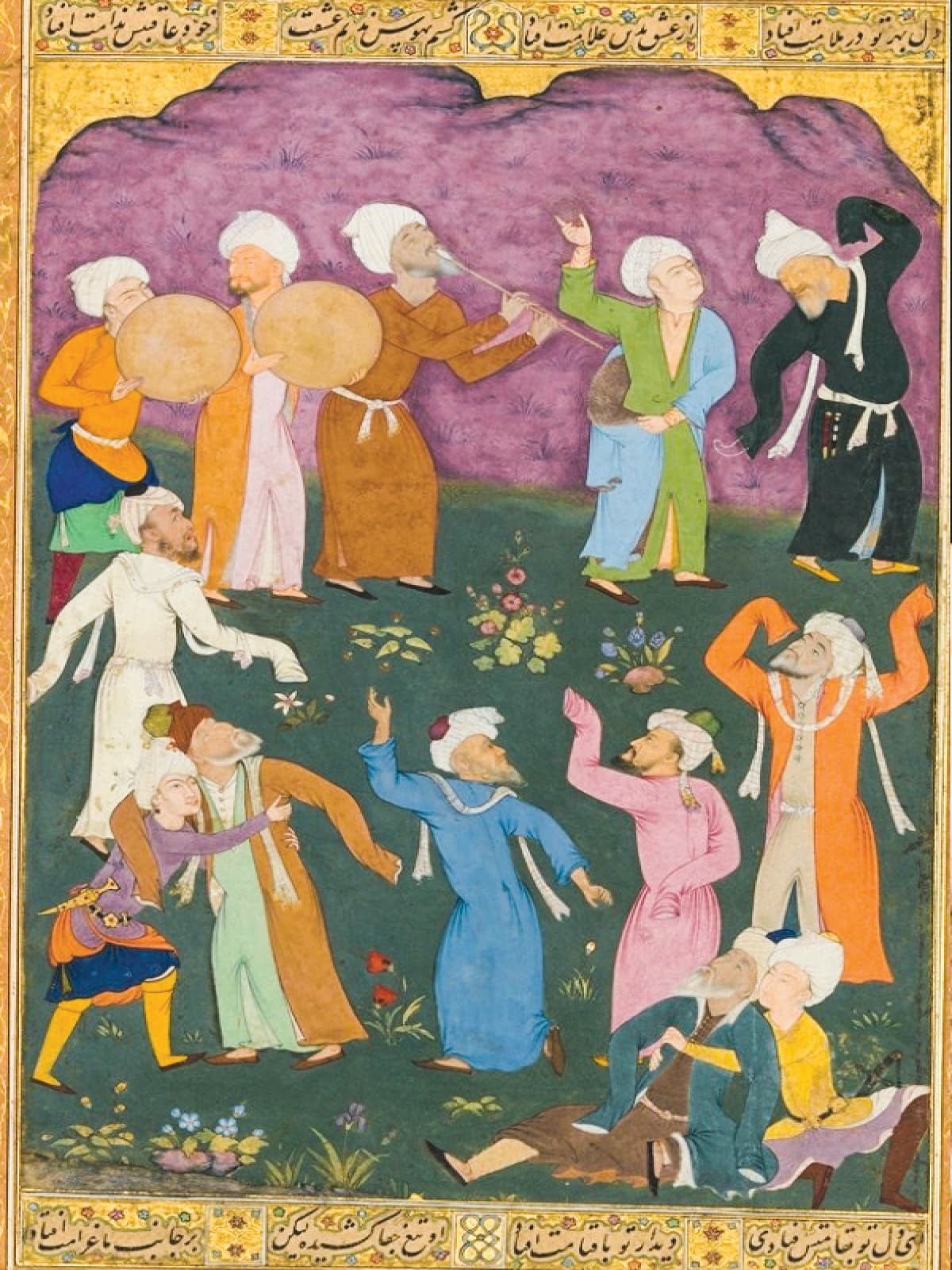
Dancing dervishes | Courtesy purchase, Rogers Fund and the Kevorkian Foundation Gift, 1955
This essay has been an attempt to dispel four myths about Islamic mysticism. The first myth is that there is a wide gap between the activities of the mystic khanqah and those of the scholarly madrasa (and that there is, thus, a vast difference between ‘Sufi’ Islam and normative/mainstream Sunni Islam). The second myth is that mystics are ‘passive’, apolitical and withdrawn from the political affairs of their time. The third myth is that mystics across the board are intrinsically ‘peaceful’ and opposed to armed jihad or warfare. The last myth is that Islamic mysticism is a phenomenon particular to, or intrinsically more suited to, the South Asian environment as compared to other Islamic lands.
All these four points are worth taking into consideration in any meaningful policy discussion of the limits and possibilities of harnessing Islamic mysticism for political interventions in Muslim societies such as today’s Pakistan. It is important to be conscious of the fact that when we make an argument for promoting mystical Islam in this region, we are in effect making an argument for the promotion of mainstream Sunni (mostly Hanafi) Islam in its historically normative form.
It
is indeed a tragedy that while the country is forging ahead in different
spheres to build a new India, its policing remains mired in a colonial
structure. The Acts passed by the states are crude attempts to circumvent the
implementation of judicial directions.
Our newspapers, until recently, were full of BJP’s tagline “Namumkin Ab Mumkin Hai”. There is no doubt that Prime Minister Narendra Modi has taken a number of initiatives in diverse fields, which would raise the standard of living of the common man and transform India into a cleaner, healthier and resurgent nation. Swachch Bharat is gradually becoming a reality. Ayushman Bharat aims to provide healthcare benefit to about 50 crore people. Electricity would appear to have reached every corner of the country. Ujjwala and Sukanya Yojana would go a long way in improving the plight of women, and so on. Different departments came out with their lists of achievements. Even if we make allowance for an element of exaggeration, these initiatives have been laudable and the progress impressive.
It is disappointing, however, that there is an area where even what was mumkin (possible) has not been achieved — it is about reformative changes in the police with a view to transforming it into an instrument of service to the people. The Supreme Court, in a landmark judgment in 2006, clearly said that “the commitment, devotion and accountability of the police has to be only to the rule of law” and that “the supervision and control has to be such that it ensures that the police serves the people without any regard, whatsoever, to the status and position of any person while investigating a crime or taking preventive measures”. The Court issued a slew of directions with a view to insulating the police from extraneous influences, giving it a measure of autonomy in personnel matters and making it more accountable. It is a great pity that even after 12 years, there has been only partial and, in some states, farcical compliance of the directions.
The states are primarily to blame. However, the Centre cannot escape responsibility for its indifference and inaction in the matter. The Police Act Drafting Committee headed by Soli Sorabjee had prepared a Model Police Act in 2006. The expectation was that the Centre would pass an Act on similar lines for Delhi and the Union Territories and that the same model would be adopted at least in those states where the same party held office. Besides, Article 252 of the Constitution gives Parliament the power to legislate for two or more states by consent and lays down that such an Act shall apply to the consenting states “and to any other by which it is adopted through a resolution passed in that behalf by the House or, where there are two Houses, by each of the Houses of the legislature of that State”.
Unfortunately, nothing of the kind happened. Till this day, the Government of India has not taken any definitive action on Sorabjee’s Model Police Act. In the absence of any initiative by the Centre, the states, 17 of them so far, have gone amok with their separate police Acts. It is ironical that while the British India had one police Act for the entire country, we are confronted with a situation where every state has a different Act with sharp differences in essential features.
Justice K T Thomas, who was appointed by the Supreme Court in 2008 to monitor the implementation of its directions, expressed his “dismay over the total indifference (of the states) to the issue of reforms in the functioning of police”. Justice J S Verma, who submitted a comprehensive report on amendments to criminal law in 2012, urged the “states to comply with all six Supreme Court’s directives in order to tackle systemic problems in policing”. It is quite mumkin, but the executive is unfortunately not prepared to give up its zamindari over the police.
The prime minister, while addressing the police chiefs of the country in Guwahati in 2014, raised hopes when he talked of building a SMART police — a police, which would be sensitive, mobile, accountable, responsive and techno-savvy. There has hardly been any follow up action and only some cosmetic steps were taken to augment the manpower and infrastructure of the forces.
It is indeed a tragedy that while the country is forging ahead in different spheres to build a new India, its policing remains mired in a colonial structure. The Acts passed by the states are crude attempts to circumvent the implementation of judicial directions. The Supreme Court has also, for inexplicable reasons, not cracked the whip so far.
The total strength of state police forces is 2.46 million and there are about 25,000 police stations and outposts across the country. It is a formidable strength. Imagine a situation where a common man does not feel inhibited in entering a police station, has a fair degree of confidence that his report would be lodged and investigated! It would be such a sea change. But is the political class keen on bringing about such a transformation? And, are the police officers themselves serious about introducing the much-needed internal reforms, which they could initiate without any political clearance or legislative backup?
We need to understand that stable law and order provides the foundation for sustained economic development. Haryana offers the most recent example of a state suffering a serious economic setback when law and order collapsed in the wake of an agitation over reservation. A healthy democracy also needs a healthy police. In fact, if police is not able to enforce the rule of law and is constrained to take directions from persons of questionable antecedents at the helm, it will be the beginning of the end of democracy.
This article first appeared in the print edition on March 28, 2019 under the title ‘A cop out’. The writer is chairman, Indian Police Foundation.
Recently, I have been ridiculed and dismissed as a 'sanghi', as a
Zionist and as an Islamophobe for arguing in my writings that Islamic clerics
and Urdu journalists engender Islamist ideas and trap innocent Muslim youths in
the web of jihadism. So, to defend me in the court of public opinion, I hereby
present my advocate Maulana Abul Kalam Azad (1888-1958), the 20th century's
foremost Islamic scholar who was born in Mecca as a citizen of the Ottoman
Caliphate and went on to become the free India's first education minister.
But first, let's meet Abdul Hakim whose son Hafesuddin is among two dozen Keralite youths who left India to join the Islamic State (IS) in Syria this year. "My own son called me a kafir (infidel). Radicalism changed my son completely," Hakim told a TV channel on 11 July. One day, the son texted: "(I will) get the jannat (heaven), here no tax, here Shari'a law only, nobody here catching me, very good place." Hakim said: "He does not like me anymore. I don't know why he doesn't like me anymore."
The radicalisation of Hakim's son is rooted in the practice of Islamic teachings.
On 27 October, 1914, addressing a large Muslim gathering in Kolkata, Maulana Abul Kalam Azad, the internationally known cleric of his era, reflected on what should be the relationship between a jihadi son and his family members.
He said:
"This biradri (community of Muslims) has been established by God...All relationships in the world can break down but this relationship can never be severed. It is possible a father turns against his son, not impossible that a mother separates her child from her lap, it is possible that one brother becomes the enemy of other brother...But the relationship that a Chinese Muslim has with an African Muslim, an Arab bedouin has with the Tatar shepherd, and which binds in one soul a neo-Muslim of India with the right-descendant Qureshi of Mecca, there is no power on earth to break it, to cut off this chain…"
There are two points here: One, in Islam, only a member of the Quraishi clan can become a caliph – a theological point based on which the Islamic State rejected Afghan Taliban leader Mullah Mohammad Omar as the caliph of Muslims and Indian Islamic scholar Mualana Salman Al-Husaini Al-Nadwi of Lucknow accepted IS leader Abu Bakr Al-Baghdadi as the caliph in 2014. Two, Maulana Azad was speaking at a time when the fall of the Ottoman Caliphate was in sight and his was a well-prepared, well-considered speech in support of global Islamism that led to thousands of Muslims leaving India to wage jihad in Turkey during the Khilafat Movement.
Maulana Azad was a fiery speaker and an editor par excellence. His speech gives a detailed insight into how Islamic clerics radicalise Muslims through sermons in mosques and speeches in jalsas (religious congregations). Outlining a view of global Islamism, which he explicitly endorsed, Maulana Azad told the audience: "If even a grain of the soul of Islam is alive among its followers, then I should say that if a thorn gets stuck in a Turk's sole in the battlefield of war, then I swear by the God of Islam, no Muslim of India can be a Muslim until he feels that prick in his heart instead of sole because the Millat-e-Islam (the global Muslim community) is a single body."
To inculcate the idea of global Islamism, Maulana Azad quoted Prophet Muhammad as saying: "One momin for another momin is like one brick assisting another brick in a wall." The word momin means "faithful Muslim" but is sociologically understood in the Indian Subcontinent as an Islamic superman (Mard-e-Momin), popularised by the Islamist poet Muhammad Iqbal who stole the idea of superman from German thinker Friedrich Nietzsche. Then Maulana Azad quoted the Verse 29 of the Quran's Chapter Al-Fatah which urges Muslims to be friendly between themselves and hard against kafirs (infidels). Maulana Azad translated the verse in following words: "[Be] extremely hard against kafirs but extremely sympathetic and kind among ourselves."
Maulana Azad accused Europe of inventing the bogus phrases like "the Eastern Problem" and "Pan Islamism" as "an extreme Satanic strategy" to divide the Muslim world, and lamented that Muslims were responding to it more like a scared "murder convict."
He said:
"Then, if it is true that a sword is being sharpened to strike in the heart of Islam, then what hesitation that we be engaged in developing a shield. If the worship of Jesus has ancient enmity against the worship of God, and this is not a new Christian conspiracy, then the unity of brotherhood is not a new tactic of the followers of Tawheed (Islamic monotheism) to defend against the attack of polytheists."
It is often argued by moderates that Islam did not spread by sword. Nevertheless, the idea of the sword has been integral to clerics' teachings. Pointing to the Ottomans who were waging jihad against Europe-backed Muslims in the Middle East, Maulana Azad said: "The last human sword of Islamic life is only in the hands of the Turks." Quoting articles from European newspapers such as the Budapest Herald and the Times of London, he said: "Europe considers it the 20th century's biggest service to civilisation to terminate 40 crore human souls, followers of Islam from anything called culture and civilisation." Although he said that "Pan Islamism" did not exist outside the mental world of Europe, in the same breath he added: "Alas, there existed pan Islamism among Muslims today! A pan Islamism for which there is no need for some secret committee of Muslims of Turkey and England to give birth to but that which we have been invited to (by Islam) from day one."
It appears that a debate was underway at the time to upgrade the MAO College into a full-fledged Aligarh Muslim University (AMU), which happened ultimately in 1920. Speaking about the need for the "Muslim University," Maulana Azad rejected territorial nationalism among Indian Muslims saying: "Remember, today, for Islam, for Muslims, any national or local movement cannot be fruitful." He rejected nationalist movements of Egypt, Turkey, Algeria and India, saying: "In my beliefs, all of this is an act of magic by the presager-Satan who makes those asleep because it does not like those sleeping [ie Muslims] to rise up." "The most important matter is that we have to build a university in Aligarh, have to collect Rs 30 lakh for this," he said and described it as a kaaba of Aligarh. More importantly, he said: "The day the university is established, wahi (revelation, of Quranic verse 5:3) … will land on the roof of the Strachey Hall (of AMU)." In verse 5:3, Allah says: "This day I have perfected for you your religion…"
Then, Maulana Azad made an astounding declaration before the Muslims of Kolkata, arguing that peace is useless and war is life. "Oh! dear brothers, remember that however rosy the idea of peace, compromise and rejection of murder and plunder in the world may be, but due to the bad luck of the world thus far the real power is the power of sword; and the source of life, the water of life is in the fountains and rivers of blood," the religious scholar declared. He was clearer: "Today, if it is asked, where to search for life of nations and evidence of life, then its answer will not come from universities of education and arts, and ancient libraries… Rather, it will be found in the metalled (war) ships which line up the coast…"
The word "peace" is frequently used by jihadi groups, but in their parlance it means the peace of Islam, which protects non-Muslims if they agree to live under that peace in lieu of jizya (tax on non-Muslims). Maulana Azad added: "That hand is pious in which the flag of compromise flutters, but only that hand can be alive which has the blood-soaked sword in its grip. This is the source of the life of (the global Muslim) nation, means of the establishment of justice…" He asked Muslims to bear in mind that at the time there was "only one sword in the defence of the religion of Allah" and that was in the hands of the falling Ottoman Caliph. He also criticised liberal Muslims who did not side with him in support of the Caliphate, saying that time has come to "discriminate between faith and kufr (non-belief)" and cited the Quranic verse 2:14: "These munafiqeen (hypocrites among Muslims), when they meet Muslims they say, we are Muslims. But when they visit alone their Satans (non-Muslims), then they say, we are with you by heart…"
In the early 20th century when Maulana Azad was speaking, about 18,000 Muslims from India went to Turkey to wage jihad and women sent their jewelleries so that the Turks could continue jihad. We are much in a better shape today than a century ago.
Towards the end of his speech, Maulana Azad was conscious of the gravity of the announcement he was about to make for jihad. "Oh! dear brothers, the matter whose announcement I do not fear, it's strange if you would be scared of listening to it." And then he declared: "I say that, on every momin who believes in Allah, his messenger (Prophet Muhammad) and his book (Quran), it is obligatory that he rise up today for jihad fi sabeelillah (jihad in the path of Allah)." And then Maulana Azad added: "The first jihad for it is the financial jihad and after it if there be any need is the jihad of body and life..." He argued that "Islam is a sale and purchase (between God and followers)" and added: "The day we accepted that we are Muslims, the same day we accepted that our lives stood sold for Islam. The meaning of Islam is to surrender our heads before the only God, and then it is upon him whether he puts it in the lap of friends or under the sword of enemies."
Maulana Azad justified the sacrifice of human lives for jihad by the citing the tradition of Prophet Abraham, who offered his son for sacrifice, an occasion marked every year by Muslims as Eid Al-Azha (the feast of sacrifice) by sacrificing animals. Like today's jihadis, Maulana Azad asked Indian Muslims to preserve the Ottoman Caliphate "in their hearts as a pure religious relationship, to consider any government of the world that is its enemy as the enemy of Islam and the ones that were its friend as the friend of Islam because friendship and enmity were not for human purposes but only for the religion of Allah."
If you have been perplexed during past three years as to why Muslims from India and other nations are radicalised in favour of the Islamic State, Maulana Azad's speech gives a clear insight into the historical Muslim mind. And he was not a 'sanghi', or a Zionist, or even an Islamophobe. Today, an estimated 30 Indian Muslims are fighting alongside the IS in Syria and more than 250 youths are under surveillance in India, while some Indians are also based in Afghanistan and Pakistan. In the early 20th century when Maulana Azad was speaking, about 18,000 Muslims from India went to Turkey to wage jihad and women sent their jewelleries so that the Turks could continue jihad. We are much in a better shape today than a century ago.
(Author's Note: Excerpts from Maulana Azad's 1914 speech used in this article are translated from Urdu book Khutbat-e-Azad (Speeches of Azad), published in 2010 by Maktaba-e-Jamal, Lahore. The book is available in India.)
Former BBC journalist Tufail Ahmad is a contributing editor at Firstpost, and executive director of the Open Source Institute, New Delhi. He tweets @tufailelif