
by Narayan Surya
- May 15, 2019
As one of the most important elections in India’s history
approaches its final phase, it is time to reflect on the broad platforms the
two main political parties have campaigned on. Bharatiya Janata Party (BJP) has
offered the trinity of vikas, national security and clean governance.
While not so explicit, the party has also gone for an
unabashed confluence of secularism and Hindutva in its campaign. Of course, the
amalgamation of these two ideas seems contradictory to a colonised mind. For
others, there is little contradiction in practising secularism through the
ideas of ‘vasudhaiva kutumbakam’.
This artificial dichotomy between the two has led to
secularism itself being turned into a cuss word. Rather than staying true to
secularism — treating all religions equally in matters of policy — it is
alleged that the secularists have blatantly institutionalised anti-Hindu
politics under the guile of secularism.
Those who disagree — and there are many — say that this is a
typical Rashtriya Swayamsevak Sangh (RSS) conspiracy theory. If this were the
case, the Muslims would not be lagging behind in all social indicators, they
argue. Moreover, they argue that it is impossible to be anti-Hindu and win so
many elections in India. The latter is a disingenuous defence.
It is rather childish to think that Congress would declare
in its manifesto that it is anti-Hindu. Of course, being aware of the political
realities that demographics entail, should there be an anti-Hindu party in
power, it must carry out its agenda subtly. Being overly aggressive can
backfire. Therefore, to evaluate whether Congress is anti-Hindu or not,
naturally forces us to scratch the surface and look beneath the obvious to
assess their policies and objectives.
In this small piece, I draw upon a small sample amongst a
plethora of incidents, where Congress could have practised secularism and
remained neutral — without any political cost — but chose not to. Being most
charitable to the grand old party, one can say that it is apathetic to the
history and values of the dharmic civilisation.
A more honest assessment, however, only leaves one
possibility — that of devious and sinister motives aimed at destroying the
backbone of the Hindu civilisation through a multi-pronged strategy of
indoctrination at young age, conversions facilitated through the financial
might, and fabrications of charges denigrating the core values of the Hindu
civilisation.
Right To Education
To the reader of Swarajya, no primer would be required about
the perils of Right to Education (RTE) Act. The United Progressive Alliance
(UPA) government introduced the act in 2009 stipulating that educational
institutes will have to admit 25 per cent poor students for free. Outwardly,
this may be a good initiative in the eyes of many. After all, who would oppose
universal education? But, the supporters of such ideas would need to perform
gymnastics to defend the following: schools run by ‘minorities’ are exempt from
such requirements.
That is, if Amar, Akbar and Anthony, each start a school
such that the schools are identical in every respect, then RTE will apply only
to Amar. Akbar and Anthony are exempt from the provisions of the law. Discriminatory
for being anti-Hindu as this is, the provisions themselves are not the easiest
to meet. The result has been that a number of schools owned by the majority,
especially those offering an affordable fee structure, closed down.
According to this report on RTE, the average number of
minority status certificates (MSCs) that the National Commission for Minority
Educational Institutes (NCMEI) issues has gone from 507 before 2010, one year
after RTE was introduced, to 1,585 in 2016. Of course, ‘evidence-based
policymakers’ can find several ‘explanations’ for this increase. So even
accepting that the numbers may be overstating the impact of RTE, a blatantly
discriminatory act will naturally give minorities, especially Christians in
this context, an edge.
Whether this discrimination was a casual oversight or a
deliberate ploy to create a monopoly of minority-owned schools around the
country can never be established. So, let us imagine a situation where the
British Empire is contemplating a policy that gives missionaries an edge in
indoctrinating children at a young age so that they can be ‘harvested’ at a
later date. Try thinking about the kind of a law such an empire would draft.
Would it look vastly different? I leave you to judge.
Communal Violence Bill
Empowered by the ‘success’ of the RTE, the UPA was
emboldened to launch a frontal assault on the Hindu fabric. This time, through
the Communal Violence Bill, giving the Centre the power to override states in
matters of communal conflicts. One can still find semblance of principles in
such an attempt. But, what went in the final proposal advocated by the infamous
and extra-constitutional, National Advisory Council (NAC), an advisory body to
former Congress president and UPA chairperson Sonia Gandhi that comprised of
well-known bigots that have consistently targeted the followers of the Hindu
civilisation through various platforms, would send chills down your spine.
Essentially, the bill gives the state the right to charge a
person from ‘majority’ community — defined as upper caste and Other Backward
Caste Hindu — for causing communal disharmony for not just an act of violence,
but for even creating an ‘hostile environment’.
Activists and intellectuals like Ram Madhav and R
Jagannathan have written extensively about some of the most draconian
provisions of this bill. As Ram Madhav writes, “if a professor discusses 9/11
in class, a person from a minority group can claim that the professor was
creating a hostile environment where the accuser was ‘hurt psychologically or
emotionally’. Eventually, this would lead to the arrest of the professor as all
offences under this bill were non-bailable.”
Interestingly, Leftist forces in India are not known for
there love for freedom of speech. Yet, what stands out is the astonishing
clarity of vision in targeting only one kind of speech here.
Targeting Hindus for a thought crime is perhaps the most
benign provision under the law. For example, an altercation on the street
between two men, one a Hindu and the other, secular, can land the Hindu in jail
without evidence. Paradoxically, if a ‘samuday vishesh’ attacks a marriage
procession of a Hindu group, as it happened in Gangapur, the attackers can then
go and charge the Hindu group for creating a hostile environment.
I fail to draw any charitable interpretation on UPA’s part
behind this. Audacious as it may sound, Sonia Gandhi is not the first one
envisioning the possibility of ruling this country through colonising the Hindu
mind and exploiting the undeniable divisions within the Hindu society.
State Control Of Hindu Temples Versus Other Places Of
Worship
There is nothing new that I am bringing out here for the
erudite readers of this magazine. Swarajya itself has done an article and a
video. Moreover, noted lawyer and activist J Sai Deepak has talked about this
issue at length.
The fundamental question is the following: what should the
role of a secular state be in dealing with religious institutions? Should it
regulate them to avoid misappropriation of funds and other malpractices?
The answer to this question can either be a “yes” or “no” depending
on one’s own value system. But, unless one has a devious motive of attacking
institutions of a particular religion, the answer to the above question cannot
be religion-dependent. Yet, this is precisely what we have in India.
By law, Hindu temples come under state control, the state
appoints the trustees, decides how to manage funds, and also taxes the income.
Ridiculously enough, churches and mosques are exempted from such requirements.
The state has no say in these matters. Below is a table from a Swarajya article
I referenced above.
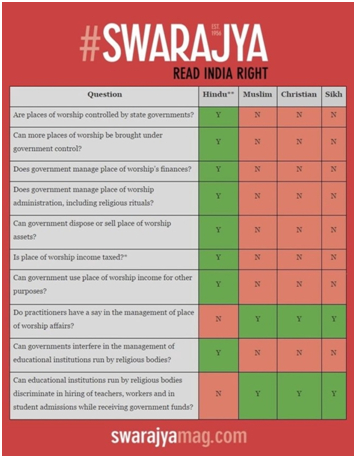
If this is not an explicitly anti-Hindu practice, I wonder
what is. I would refer the interested reader to the other — more informed —
sources I referenced above for details.
26/11, Malegaon And The RSS
Some events change the course of history. In India’s case,
26/11 was one such event. While the attack itself exposed Pakistan, thanks to
Tukaram Omble, the police officer who was martyred catching Ajmal Kasab alive,
the attack also derailed a much sinister plot by the UPA that was developing in
the months leading up to 26/11. A few months before 26/11, there were bomb
blasts in Malegaon for which Lt Col Prasad Purohit was arrested. Enough
evidence is available in public domain suggesting that he was falsely implicated.
One must add that the verdict is pending in the court.
However, what stands out is the alacrity with which the then
essentially defunct Home Ministry acted in arresting Lt Col Purohit without
evidence, and labelled it as Hindu terror. One must remember that in those
days, India was witnessing literally a bomb blast every month. Facing the heat
of rising Islamic terror and the looming election cycle, the prospects were
looking ominous at one point. And so, out of thin air, Congress concocted the
narrative of saffron terror about which a former bureaucrat R V S Mani has
written in his book.
While this was before 26/11, Congress did not relent even in
the face of such a gruesome terrorist attack. Just after 26/11 — despite
Kasab’s arrest — Digvijay Singh released a book by one Aziz Burney titled 26/11
RSS ki Saazish, not once but twice.
Essentially, the Congress leadership was trying every trick
under the sun — from falsely implicating Hindus in terror attacks to peddling
conspiracy theories — to ensure that the charges of Hindu terror stuck. But
truth has its way of revealing itself as the charges did not stick.
Congress supporters might say that many Muslims also,
unfortunately, languish in jails for false terror charges. Therefore, they
would argue, falsely implicating a person does not establish a larger
conspiracy. There may be some merit in this defence, but not one incident comes
to mind where a terrorist used Hinduism as a cause for carrying out a terror
attack.
Therefore, it seems rather odd that the then ruling
dispensation would explore a non-existent link as its first point of
investigation in Malegaon, and eventually charge seemingly innocent Hindus to
celebrate victory for unearthing ‘saffron terror’.
Due to space constraints, it is impossible to get into the
details of several other incidents that merit some mention. For example, take
the case of illegal Bangladeshi immigration in Assam. It is no secret that
illegal Muslim immigration creates a permanent vote bank for the Congress.
Pro-immigration parties worldwide endorse such policies for creating a support
base.
However, the plight of displaced Kashmiri Pandits should
have warned any government sympathetic to the Hindus of the disastrous
consequences of changing demographics in a particular direction. And yet, for
decades, the Congress actively encouraged such illegal Bangladeshi immigration.
Today, in 14 out of 20 districts in Assam, Muslims are a majority.
As Prafulla Kumar Mahanta, the leader who signed the Assam
Accord with the then prime minister Rajiv Gandhi said, Congress had several
chances to implement the accord but it chose not to. He goes on to say that
fundamentalists from across the border intend to turn North East into an
Islamic country and there are ISI reports to this effect. The risk, he says, is
that Assam may turn into another Kashmir.
This may be terrible news for the native Assamese. But,
going by the Congress leadership, one wonders if they too want the same.
Then there are incidents like the inauguration of the
Somnath Temple. It is well-known that Jawaharlal Nehru disliked the idea of
Rajendra Prasad, the president of India, attending the inauguration of the
restored Somnath Temple. In Nehru’s worldview, the president of a secular
country should not attend a religious event. One can see merit in this
principle. But, here was a civilisation that withstood a series of assaults for
several centuries. Somnath Temple was a mark of the resilience, grit and
character of this civilisation. That the prime minister should be opposed to
the celebration of restoration of merely one temple amongst thousands that were
destroyed by invaders reeks of inherent biases.
However, Nehru was far more magnanimous in his opposition,
or his biases, than his progeny. But, what one gathers from this incident is
that right from independence, the Congress party was unsympathetic to the
revival of a subjugated civilisation.
Another case in point going back to the Nehru era is that of
the assassination of Mahatma Gandhi. In 1948, after Gandhi’s murder, Vir
Savarkar, a Hindutva icon, was arrested. To keep the story short, none other
than Dr B R Ambedkar, law minister in Nehru’s cabinet, had a secret meeting
with Nathuram Godse’s lawyer L B Bhopatkar to warn him that there was no
evidence against Savarkar but that the cabinet was acting on the “whims of one
man” to implicate him. That one man was none other than Nehru, according to
Bhopatkar. (Ref: Manohar Malgonkar’s book The Men Who Killed Gandhi, Hindutva
And Dr Ambedkar and Revealing Mahatma Gandhi's Murderer Nathuram Godse's Ties
With RSS).
Of course, in some of the allegations above, sceptics would
point to lack of ‘conclusive’ evidence. But, from state control of Hindu
temples to RTE and Communal Violence Bill, from Kairana to Bodos, Congress’
sectarianism has systematically favoured minorities. Sonia Gandhi has wept when
the terrorists were killed in the Batla House encounter but did not shed a tear
for Lt Col Purohit. For every such charge, there is always some ‘explanation’.
One must remember, the art of winning civilisational battles
lies in spotting early trends and acting on them. In a game of chess, the seeds
of endgame are sown in the opening. But, once in the endgame, one cannot go
back to the opening to reverse some blunders.
Unfortunately, time only runs in one direction — forward.
Thankfully, there is every reason to be optimistic for we are course
correcting.


