
http://indiafacts.org/history-asana-exercise-india/
Asanas have been used as part of exercise traditions in India, just as they have been part of meditation or Yoga Sadhana traditions.
Asana and Exercise Traditions:
Related but Different
Martial Arts and Indian Exercise
Traditions

Weight Lifting, Weapon Lifting and
Physical Development
Gymnastics of India and the Gypsies
Indian Dance

Older Vedic Origins
Conclusion
Asanas have been used as part of exercise traditions in India, just as they have been part of meditation or Yoga Sadhana traditions.
Indology | 23-10-2017
In the
following article, we will examine the origins of the asana side of Yoga in
India, including relative to Vedic teachings. Asana is the aspect of Yoga least
detailed in older Vedic and Yogic texts and is the aspect of classical Yoga
given least importance overall. Sometimes little more about asana is said in
the older texts than the need to sit straight (Bhagavad Gita and Upanishads),
or to maintain a comfortable pose (Yoga Sutras).
This has
led some people to think that the active asana approaches and movements, such
as practiced by many modern Yoga groups, were not part of the older Yoga
traditions or were not known in India. It has also gotten some to hold that
active or strong exercise methods, like calisthenics type movements, only
entered India recently through Europe and were previously unknown, with Yoga
asanas being the main form of exercise taught in India. This plays into
cultural stereotypes that Indians are physically weak and the Europeans
physically strong – a view that arguably borders on racism.
To
adequately approach this issue, we must first examine the greater exercise
traditions of India, including Vedic martial arts, and not limit ourselves to
yogic texts. We must also understand how Yoga asana and exercise in general
relate, their similarities and differences, and their respective places in
Indian culture.
Yoga was never primarily an exercise tradition and we cannot look to
yogic texts for understanding the exercise traditions of India. Dhanur Veda or the Vedic martial arts is the main basis and oldest
form of exercise tradition of India and one that has continued to develop over
time. Yoga and Dhanur Veda overlap to some degree, but more active forms of
exercise connect primarily with Dhanur Veda and only secondarily with Yoga.
Asana and Exercise Traditions:
Related but Different
There has
been a tendency to look at asana or yoga postures as the main exercise system
practiced historically in India, with any more active exercise approach like
calisthenics and weight lifting, being perhaps a recent borrowing from the
West, or even something not particularly Indian, with Indians being more mental
than physical types. This plays into stereotypes of India as not having strong
martial or military traditions, some arising from the recent emphasis on Gandhi
ahimsa in the country. Several scholars of modern Yoga have proposed something
of this kind. A deeper examination, however, finds this view to be inaccurate
or incomplete.
First of
all, Yoga asana, as part of classical Yoga traditions like the Yoga Sutras,
was never meant as a merely an exercise or fitness system. Asana in Sanskrit
means a chair or a seat, and in terms of bodily positions implies a seated
pose, and by extension any pose assumed or held for an extended period of time.
Asana in classical Yoga was not meant as simply a type of physical exercise,
which is called vyayamain Sanskrit, but as part of Yoga
practice, called Sadhana, a spiritual discipline resting
upon the ability to sit or be still for long periods of time for the practice
of meditation. Traditional Yoga asana was not meant as a workout or fitness
drill. However, we must recognize that other exercise traditions did exist in
India, besides Yoga asanas, which were more active in nature, and sometimes did
use asanas and vinyasas along with other stronger exercise practices.
Yoga asana
could be used as part of other Indian exercise approaches, sometimes serving a
role like preliminary warm ups or stretches. In these cases, case such asana
practice was not regarded as Yoga, which means a spiritual path in Sanskrit,
but as a means of bodily health and strength. In other words, asana as exercise
did exist in ancient India but as a different orientation from asana as
classical Yoga, which was a tool to still the body for
meditation, not meant as a physical workout. The use of asana in exercise
approaches should be discriminated from its role in meditation approaches,
though some natural overlap exists.
India as a
vast subcontinent and great ancient civilization has its own ancient and
diverse traditions of exercise, martial arts, gymnastics and dance that cover
the full range of exercise practices, including every sort of callisthenics.
India did not require the Europeans in order to bring the idea of physical
fitness or exercise into the region. The same situation existed in China and
the rest of Asia that also had slower or more internalizing forms of exercise
like Yoga or Tai Chi, which did not mean that they did not also have stronger
exercise approaches as well. India has its own long traditions of martial arts.
Martial Arts and Indian Exercise
Traditions
India has a
great heritage of its Kshatriya, its martial, military, aristocratic or
princely class, just as most of the world had until recent times. It is among
these traditional martial arts that we can find the most diverse and extensive
traditions of exercise. Even the Vedas speak of the unity of Brahma and Kshatra
or spiritual and warrior traditions and the need to honor both.[i] Hindu
warrior traditions continued through history and developed along with changes
of warfare through the centuries.
The Vedas
have a special tradition of martial arts called Dhanur Veda,
which is one of the four Upavedas or secondary Vedas.
Such Vedic martial arts like Kalari remain popular in South India to the
present day, though many others have probably been lost in the course of time.
Dhanur literally means a bow, so archery was one of these martial arts. Yet
India has had a long tradition of sword fighting as another martial art.
Source: Wikipedia
The most
famous ancient guru of the martial arts or Dhanur Veda, who is found in the
Ramayana as well teaching the martial arts to Rama and Lakshman, is the rishi
Vishvamitra, a famous Rajarshi or royal sage, combining both Kshatriya and
Brahmin lines. Vishvamitra is the seer of the third of the ten books of the
Rigveda and of the famous Gayatri mantra, the most widely used Vedic mantras
for all the Hindus.
Hindu
history and stories like the Puranas laud many ancient warriors and kings,
along with their great victories, a number as chakravartins, meaning
world-conquerors or universal rulers. The Vedas themselves contains many verses
in praise of ancient kings and their martial exploits, like Trasadasyu, with
some Vedic hymns composed by royal sages like Sudas or Mandhata.[ii] Great
warriors like Arjuna or Rama had special weapons or astras created through the
use of mantra and meditation, and harnessing the forces of nature. This martial
aspect was always there with the different Hindu, Buddhist and Jain dynasties
in the region.
Martial
arts are well known in Buddhist monastic traditions of China and Japan. These
are attributed an Indian origin to Bodhidharma, who came from the famous city
of Kanchipuram, not far from modern Chennai. Bodhidharma was said to have
brought both Zen and Martial arts to China.
Hindu
monastic and sadhu traditions are well known for their martial lines, like the
famous Naga sadhus who wield tridents or Trishulas to the present day, leading
the marches of monks for the great Kumbha Mela gatherings. A Hindu monastic
order today is called an akhada, which also means a gymnasium (much like the
Greek Academy). The monastic orders have asanas, exercises and martial arts, in
part to keep the monks active and physically fit. Many Hindu monastic orders
over the past thousand years were formed to help protect Hindu society from the
attacks of Islamic armies and had such martial sides.
The Indian
warrior class also used mantras and called upon deities for success in battle,
like the famous battle cry “Jai Sri Ram”, that is still the war cry of the
Indian army of the state of Uttar Pradesh. The Goddess Durga was said to have
given the royal sword to the kings, including such figures as Sivaji of
Maharashtra, or Guru Gobind Singh and King Ranjit Singh of the Sikhs.[iii]
The
colonial British army owed its prowess to its Sikh and Gurkha soldiers from India
and Nepal. Gurkhas mainly worship the Goddesses Kali and Durga, Hindu martial
Goddesses, and claim connection to Gorakhnath, the main Nath Yogi behind Siddha
Yoga and Hatha Yoga traditions. Their war cry is “Jai Ma Kali, Here Come the
Gurukhas.”
Hatha Yoga
itself arose as part of a martial and monastic approach to Yoga. Hatha itself
means force in Sanskrit.
Weight Lifting, Weapon Lifting and
Physical Development
Indian
martial arts training involved the use of heavy weapons including swords and
the mace (gada). Bhima, one of the five Pandavas and companions of Lord
Krishna, was famous for his use of the mace and defeated Duryodhana in a mace
fight. Hanuman also was famous for his mace. Such heavy weapon training served
like weight lifting to build the muscles.
Even the
use of the bow, particularly the long bow that we find in India depictions like
that of the Ramayana, requires a lot of muscular strength in order to use.
Rama’s story was that only he could string the bow of Lord Shiva as it was so difficult
that no other warrior could do so. All the other princes tried and failed. Rama
gained Sita as a wife as his reward for stringing the bow. Rama was well known
for his expertise at archery.
India has
extensive traditions of wrestling. In fact Lord Krishna was regarded as a great
wrestler and was thought to have defeated his enemy Kamsa in a wrestling match.
Such wrestling traditions employed different exercise approaches than Yoga and
much like wrestling from throughout the world.
India has a
long tradition of depiction of athletes, warrior and muscle men, as does most
of the cultures of the world. The great avatar and emperor Lord Rama is the
forest of these, portrayed with his long bow and a strong physique. Hanuman,
his monkey companion, is a kind of Indian superman, noted for his muscular strength
and miraculous powers. Bhima, the strongest warrior in the Mahabharata, is
another. Another is Parashurama, who precedes Rama as an avatar of Lord Vishnu,
who wielded an axe to conquer the deviant Kshatriyas or adharmic and
unrighteous kings.
Modern
Hindu Yogis were not all emaciated ascetics and many developed great physical
strength. Even the forms of Hindu deities like Shiva are not portrayed weak in
form or stature, but as physically strong. In addition, the typical Himalayan
Hindu Sadhu lives in a cold mountain climate, with little food and clothing,
developing an ability to adjust to the elements, relying on physical strength
and endurance.
Gymnastics of India and the Gypsies
India has
had a long tradition of gymnastics as well. This is best revealed by the
circuses in India, which remain popular today, and have a great antiquity. The
gypsies, who originated in India, brought these gymnastic traditions to the
Europe, along with their circuses. There were whole castes or communities who
kept up such traditions of physical prowess and dexterity and are still found
in India today. There were entire classes of such circuses and entertainers in
ancient texts called Sutas and Magadhas, mentioned as early as the Manu Smriti,
the main ancient Hindu law code.[iv]
Indian Dance
India has
many traditions of classical dance like Kathak, Bharat Natyam, Odissi, and
Kathakali. Each region of India has its own type of dance. These require
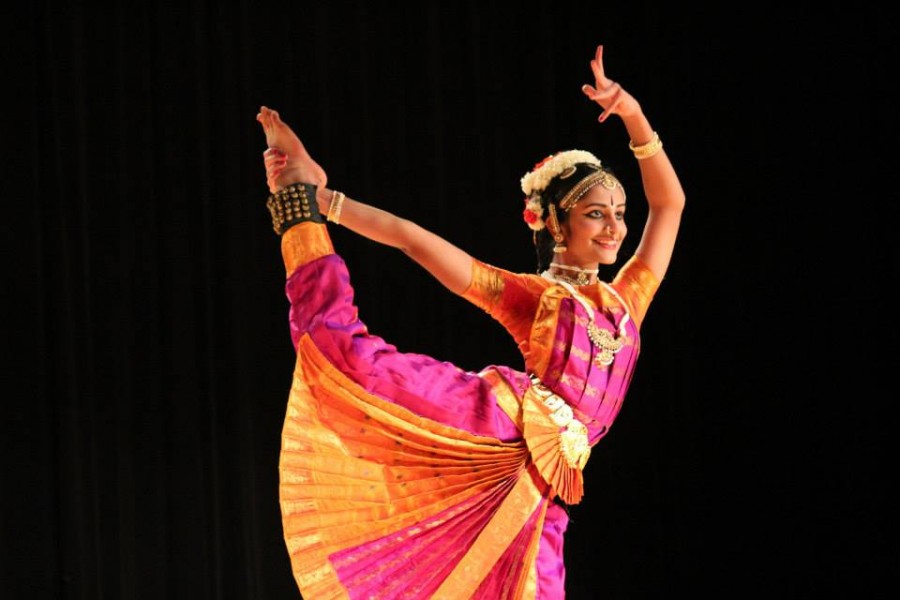
strength and include gymnastic movements of various types. Asanas are used by
Indian dancers to gain great flexibility, which is an old tradition.
Source: https://hillsborough-voice.com
Shiva who
is the Lord of Dance is also the Lord of Yoga and the Lord of Asana in Hindu
thought. The 108 dance poses of Lord Shiva include many movements and vinyasas.
The cross over between classical Indian dance and Yoga is quite extensive
historically and extends to the present day in which dancers practice various
asanas to help gain greater flexibility.
Older Vedic Origins
We find
ancient Indus or Harappan seals with figures in various Yoga postures, sitting
and stretching.[v] The Vedas themselves reflect traditions of martial art and
dance. Many Vedic deities have warrior characteristics and are portrayed as
possessing great strength and energy including Indra, Agni and Soma. Indra and
Rudra among the Vedic deities are also referred to as dancers. Rudra, who is
later connected with Lord Shiva, is also a famous archer in Vedic texts,
bringing in the Dhanur Veda connection.
The
Mahabharata, India’s great epic, abounds with stories of great warriors and
their magical powers, combining martial arts like archery with yogic tools like
mantra and meditation, like the case of Arjuna, Krishna’s companion. The same
is true of the Ramayana, the most famous epic of South Asia. Rama performs a
series of mantras to the Sun God to enable him to defeat Ravana in battle.
Hanuman was well known for his yogic and martial prowess. We can therefore
speak of a long history of ‘martial Yoga traditions’, which have included a
variety of active exercise traditions as well.
Conclusion
Callisthenic
traditions tend to be alike worldwide because they are working with the same
human body and its normal range of movements. Similarities in such approaches
between India and the West does not prove that India had no exercise traditions
before the modern period. It is part of the prejudice that portrays Indians as
physically weak and the Europeans as physically strong.
This is not
to say that there was no borrowing of exercise methods between different
cultures, but that similar practices had existed in India, just as in other
Asian countries like China. Modern Yoga in the West does include influences
from western movement, exercise, massage and body work practices. But this does
not mean that there was no similar exercise approaches in India going back for
many centuries, or that anything of this type that one may see in recent India
must have recent western origins and cannot be India based.
Asanas have
been used as part of exercise traditions in India, just as they have been part
of meditation or Yoga Sadhana traditions. This is a different application of
asana, however. We must discriminate between these two different usages, rather
than think that one excludes the other. It would be good if there were more
research on the exercise, martial arts, gymnastic and dance traditions of India
and the place of asana within these. No doubt much is yet hidden, particularly
how asana can be applied with more active forms of exercise approaches.
This means that the active type of Yoga commonly practiced in the West
today does have antecedents in India, but that it was not necessarily called
Yoga, a term used more specifically for meditation practices. It was part of Indian martial arts, dance, exercise and gymnastic
traditions, which had their own spheres of application that included areas of
fitness not ordinarily covered by Yoga. These exercise
approaches did extend to India’s Yogi, monastic and sadhu traditions and
communities, however, and could be connected to deeper meditation practices.
They were also part of India’s Kshatriya or warrior class traditions that
included using various weapons.
Asana has
an important place in exercise traditions as well as in spiritual traditions
like classical Yoga, and there is a good deal of overlap between the two. Yet
we should discriminate between these two levels of its usage. Classical Yoga
was not a fitness system, but asana was also used as part of other Indian
fitness systems, particularly martial arts, even when the rest of Yoga was not
brought in along with. Hatha Yoga crosses over both these practices, having a
connection to martial arts as well, but primarily uses asana mainly to prepare
the body for meditation.
[i] Unity
of Brahma and Kshatra, Yajur Veda
[ii] Vedic
kings and warriors
[iii] Note
the Naina Devi temple in Punjab for Gobind Singh
[iv] Sutas
and Magadhas
[v]
Harappan Yoga Seals
Adapted from Vedic Yoga: the Path of the Rishi


No comments:
Post a Comment