
05/09/2017
Vamsee Juluri,
Contributor, Writer,
Novelist, Professor of Media Studies at University of San Francisco
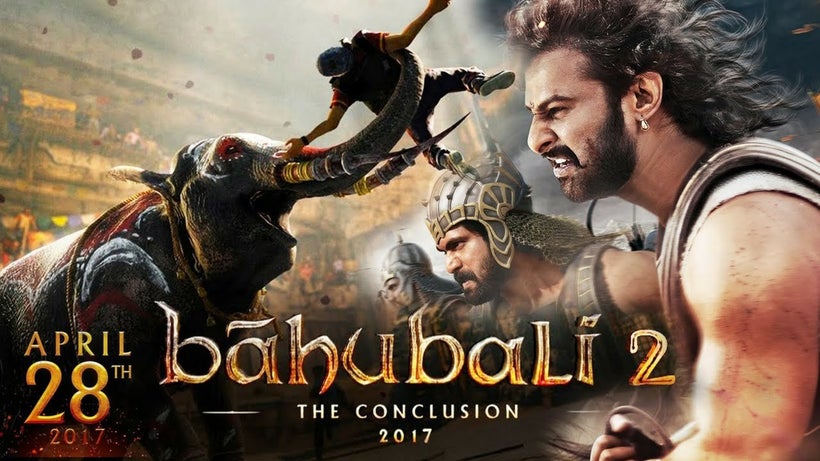
To understand
the phenomenal success of Baahubali 2 and what it means for Indian viewers
around the world, we must think about not only the historic role played by
Indian popular cinema in representing political and ethical visions, but also
about what has been happening in terms of stereotypes and misrepresentations of
Indians and Hindus in particular in news and popular culture.
The same week
that Baahubali 2 stunned box-office watchers by earning enough revenues to
become the third biggest movie in the United States that weekend (a first-time
record for an Indian production), a young Indian American boy, an eleventh
grader from Palo Alto, wrote a piercing commentary on the utterly dehumanizing
stereotypes that populate the American television landscape at the moment.
A few weeks
earlier, hundreds of Hindu Americans in several American cities had come out
into the streets to protest CNN’s inaccurate, stereotypical and cheaply
sensationalistic Believer episode on cannibals and caste in India. Their fears
were not simply about getting better press for Hinduism. The community was, and
still is, facing widespread (if often understated) fear about their safety and
future in America following the killing of a young Hindu engineer from my
hometown of Hyderabad in Kansas City.
Hindus in
America, especially of a younger generation, can see something is not right.
Hindu American children have spoken up against errors and biases in the school
textbooks in California. There is a problem when the story about being Hindu is
told by others, or by some alienated and poorly informed South Asian elites who
tend to blame the victim. We are neither Slumdogs, nor people who use slurs
like “Slumdog.”
An Indian Vision of India’s Past
Baahubali is
an audacious celebration of being not just Indian, but being Hindu. Its
popularity has to be understood in relation to not only the timeless tradition
of the Ramayana and Mahabharatha, but also in relation to a newer pop culture
genre in India of historical fantasies inspired by the epics. The genre stormed
the market in 2010 with the runaway success of the Shiva Trilogy by Amish
Tripathi. The important thing about this genre, and this is evident in
Baahubali too, is the the evocation of modern and liberal sensibilities in the
social world of their characters. Women fight, speak up for their rights, and
authority is constantly questioned. Heroes are rarely preordained prophets or
avatars, but ordinary human beings who struggle to earn their place. Critics
see this genre as a right-wing fantasy, but as I wrote some time ago in Foreign
Affairs, that view is shallow, and the popular rediscovery of India’s
civilizational heritage is better understood as a generational process of
decolonization from a British-Mughal view of Indian history.
Baahubali
tells the story of two generations of a royal family set at an unspecified time
and place in India’s past. It is a tale of palace intrigue and war drawing on
the epics as well as a modern Indian cinematic idiom of male-star-worship. But
what sets it apart from virtually any movie made in India is the absolute
panache of its production. The cities and palaces tower up to fill the screen,
as do the gardens and the battlefields. Every one of the hundreds of actors is
in character, and the screen invites you to soak in every frame like a graphic
novel panel (albeit a serious and dramatic one, in the vein of 300, right down
to muscular heroes and villains facing off with chariots and spears and
explosions of splinters and rubble).
The movie is
an experience of beauty, most of all, and it marks, in some ways, a return to
Telugu cinema’s artistic roots from an earlier era. But unlike the older
movies, it is not gentle at all, but breathlessly adventurous and violent. It
is so sure of itself, and what it is doing to its viewers, that the
intermission is preceded by a sign saying “let’s give the people of Mahishmati
(the imaginary kingdom in the movie) a chance to breathe.” It takes absolute
bravado to say that, and it is justified.
That
confidence, in some ways, is part of the desire to self-represent that
Baahubali’s global Indian audience perhaps wishes to see fulfilled. Unlike most
Indian productions that cut short on detail, Baahubali shows muscle literally
and otherwise in its grandeur and vision. It speaks to and from an aspirational
Indian generation that can announce itself, and say it can speak to the world
on its terms. This is a desire that has been circulating in Indian media and
popular culture since the early years of economic liberalization in the 1990s,
of Indian success, and “arrival” of sorts in the global marketplace.
However, what
makes Baahubali important is the fact that it is explicitly, enormously, and
exuberantly Hindu in its vision and expression. Its popularity topples every
chic theory about South Asian history and cultural politics currently being
taught in universities around the world. It is a non-Hindi, non-hegemonic,
South Indian, regional (and “Dravidian”) language vision of Indian
civilization, and it is Hindu. It is as effortless in its sweeping recognition
of diversity as it is of its underlying spiritual-ethical-cultural
architecture. Simply put, it challenges the “idea of India” as a modern,
secular post-1947 invention fashionable in academia and increasingly in India’s
dominant film industry based in Mumbai, the Hindi language industry known
around the world as “Bollywood” (the Telugu industry that made Baahubali is
based in my hometown of Hyderabad and is known locally as “Tollywood”).
The cultural
tensions between Bollywood and Baahubali are accurately reflected in a popular
meme going around in social media that suggests that films that respect
Hinduism will earn a lot more than films that disrespect Hindus. The image
contrasts Baahubali with an earlier Bollywood blockbuster, P.K., a comedy about
an alien who mocks Hinduism. In P.K. the wide-eyed alien (played by activist
actor Aamir Khan), who supposedly exposes the failings of all organized
religions tip-toes around Islam but hits Hinduism ruthlessly. For example, one
scene in P.K. depicts Hindus mistaking red-colored paint (from chewing paan, or
betel leaf) on a rock for a sacred mark and offering worship to it as if it
were a deity. It is exactly this sort of ignorance about the cosmology, aesthetics,
and practices of India’s largest religion by Bollywood elites that has turned
the loud celebration of Baahubali into a representation of an India long mocked
and derided by its postcolonial elites.
The nation,
it seems, no longer belongs to those who believed they had a monopoly on its
definition.
Generations Change, Dharma Remains
What kind of
a vision then does Baahubali present about India and Indians? Unsurprisingly,
critics have accused it of ignoring Muslims (although a brief scene in both
movies alludes to friendly contact and trade with Muslims in other lands), and
of celebrating the conquest of “Dravidian deities” by Aryans (a strained effort
to perpetuate the old colonial Aryan Invasion Theory that no honest scholar
supports any more). We see references to many different deities and forms of
worship in the movie, and religiosity as a force for courage and justice (there
is a tremendous, Ozymandias-like symbolism that appears in the last scene of
the movie, as if to say all tyranny will fall ultimately before the good deeds
and legacies of our ancestors). However, the central idea of the movie is that
of dharma, which implies not blind faith but a constant search for knowing and
doing what is right. In one of many majestic royal palace scenes, the good
prince argues eloquently in the presence of the queen mother and the courtiers
for the supremacy of dharma over scriptural law.
And how
dharma is depicted in the movie is a fascinating statement on generational
change in how it is seen and practiced in India today. Dharma evokes both the
continuity of traditions in some ways, and its rejection. For example,
Baahubali refuses to behead a buffalo for the mother goddess on the cusp of a
major battle in the first movie (and offers a drop of his own blood as offering
instead), but in the second part we witness a fleeting and soaring image of
bulls being raced by young men through the farms in a lush, green landscape (a
reference to the controversy last winter in India over PETA’s attempts to ban a
traditional Tamil bull-racing festival). Baahubali (junior) also doesn’t
hesitate to uproot a sacred stone icon of Shiva (an act normally considered
sacrilege) but also restores sanctity, and love, by carrying the heavy stone
Lingam to the river where his devout mother can offer water-worship to it more
easily.
But beyond
the cinematic symbolism designed to spectacularize the hero’s muscles as much
as his heart, is the narrative around dharma as selflessness, sacrifice, and
living for the well-being of others. Baahubali sacrifices his throne in order
to marry the princess he has given his word to, and then, when pushed to the
corner even more by his jealous and powerful cousin who has replaced him as the
ruler, walks away penniless into the world of the common people (a reference to
the predicament of both Rama and the Pandava Princes from the Ramayana and
Mahabharata, respectively). While in exile, he does what the Indians of Silicon
Valley and the global Indian workforce like to do, and designs machines to help
the poor farmers do their work with less back-breaking toil. But the
warrior-engineer-sacrificing hero’s real backbone in the story comes not from
his own goodness, but from the fierce courage ultimately of the women in the
story. Even as Baahubali readily accepts his cousin’s conniving in order to
please his adored queen-mother, his wife speaks up for him and insists that he
be restored as King simply because that is what the people want.
One of the
most powerful moments of Baahubali 2 is the coronation scene of the evil
prince, about halfway into the story, when a massive palace courtyard with
stratospheric staircases and pavilions is overrun with the faces, and the
political will, of the people. Baahubali has stepped aside for his cousin to be
crowned, but when his turn comes to be appointed as the chief of the army, the
people cheer him so loudly (and the digital war elephants too), that the royal
umbrella above the throne breaks loose. The symbolism is incredible. What India
sees, and feels there, perhaps is the powerful hope that even if the corrupt,
cruel, and undeserving assume power over others, the strong arm of the selfless
ones is what holds the real power in the end.
Baahubali has
been described as the rediscovery of India’s traditional ideal of kshatra, or
warrior-spirit, after decades of its suppression by Gandhian notions of
pacifism. It is that, and a lot more too. The rest of the world accustomed to
dogmatic and dated textbook theories and pop culture stereotypes about what the
Hindus are supposed to be like might find it hard to get used to or understand
at first. But in the end, it has to return to the inevitable, to the vision of
the infinite that has sustained the life of a people threatened with extinction
more than once before in history only to find the people and their lives
surviving, and rising, again and again.


No comments:
Post a Comment