
https://swarajyamag.com/culture/indias-legends-hold-cluesto-history-and-geology-testifies-it-but-do-we-care
SNAPSHOT
Every region of India has its popular legends that have been orally
handed down for millennia but are not documented anywhere. We ignore these at
the peril of erasing our historical memory.
The truth is not so much that our ancestors were a people with a poor
sense of history but that we, in modern times, have an unjustifiably poor
opinion of our sense of history.
Indians face a double whammy. On one hand, there is the received wisdom
that Indians have a poor sense of history and are appallingly poor at recording
historical evidence. On the other, even career historians dismiss most of our ancient literature and popular legends out of hand as
being pure fantasy, and unworthy of being regarded as a source of historical
information. This is strange, considering that there were very few scribes in
the past, and writing was extremely rare. Thus, apart from the sacred
literature, unwritten oral tradition and popular legends were the only way to
preserve and transmit knowledge. Also, it is baffling why India should be treated
differently: but for Biblical legends, no one would have thought of
archaeologically exploring Egypt or Mesopotamia, and their ancient
civilisations would have remained undiscovered.
Many enduring legends may have a basis in historical events. In a stunning
paper published in the leading journal, Science in 1975, top geologist of
the University of Miami, Cesare Emiliani and his colleagues reported evidence
of huge volumes of meltwater flowing down the Mississippi River into the Gulf
of Mexico from the North American ice sheet around 11,600 years ago. The
meltwater would have caused the sea-level worldwide to rise by 1-2 metres
annually, inundating coastal areas where pre-and early agricultural populations
were concentrated (owing to proximity to an easy source of food – fish). Their
date tallied uncannily with that given by Plato for the deluge that destroyed the legendary Atlantis. While this
may be a quirky coincidence, the actual episode itself may provide a basis for
understanding how cultures as far removed as the Indian, Sumerian, Greek,
Native Americans and Pacific Islanders all have their own flood legends – they are probably memories of historical events, embellished
over time. A New York Timesarticle covering this research can be
read here.
There were many such events in the last 12,000 years (a period known as
the Holocene), and such legends may refer to local deluges. China has its own
flood legend. Only last year, researchers reported that its basis may lie in an
earthquake that occurred around 1920 BCE, triggering a landslide, which caused
the damming of the Yangtze River. Inevitably, this dam – estimated to be the
size of the Hoover or Three Gorges dam – catastrophically burst a few months later.
Indians too have their flood legend, that of Vaivasvata Manu, which
occurs in the Satapatha Brahmana of the Sukla Yajur Veda, and is repeated in
the Mahabharata and the Puranas.
But it is not just flood legends that can be corroborated by geological investigations. There is the legend of Parasurama reclaiming land along the Konkan and Kerala coasts and settling people there. There is also the legend of Dwarka – possibly known to every child in India – being built by Krishna on land reclaimed from the sea, and which was eventually submerged in the sea in a cataclysm after his death. Then, there is the episode of the sage, Vasistha’s suicide attempt, which is not connected with the sea at all. As we shall see, geological data from the subcontinent may provide tremendous insight into the historical events which gave rise to these legends, and that these legends may not be merely flights of fantasy.
But it is not just flood legends that can be corroborated by geological investigations. There is the legend of Parasurama reclaiming land along the Konkan and Kerala coasts and settling people there. There is also the legend of Dwarka – possibly known to every child in India – being built by Krishna on land reclaimed from the sea, and which was eventually submerged in the sea in a cataclysm after his death. Then, there is the episode of the sage, Vasistha’s suicide attempt, which is not connected with the sea at all. As we shall see, geological data from the subcontinent may provide tremendous insight into the historical events which gave rise to these legends, and that these legends may not be merely flights of fantasy.
Vasistha’s Suicide Attempt, And How The River Sarasvati Saves Him
Vasistha’s persecution by Viswamitra for refusing to surrender his cow,
Nandini, to the latter is well known. The Mahabharata describes how, when his
son, Sakti dies through the agency of Viswamitra, the grief-stricken Vasistha
attempts to end his own life in many different ways, but is always saved by the
elements. Once, he tries to drown himself in the mighty river, Sarasvati, but
the river saves him from the sin of suicide by splitting into numerous shallow
streams. Sarasvati’s kindness proves timely, as the rescued Vasistha learns
that his widowed daughter-in-law is pregnant, and he resolves to live so he can
support her, and mentor her child, who turns out to be the great Parasara.
Geology tells us that the Sutlej was earlier a feeder stream of the Sarasvati (this was at least 5,000 years ago, no later), but subsequently
changed course to join the Indus as a tributary, and, in the process, braided by splitting into many narrow channels. The ancient name of the
Sutlej, Satadru literally means “hundred streams”. The archaeologist, D P
Agrawal says the story of Vasistha’s suicide weaves in a vivid memory of this
event, given the remarkable accuracy of the description. In his book, Ancient Cities of the Indus Valley Civilization, the
University of Wisconsin archaeologist, Mark Kenoyer also cites this story as an
example of how historians may have been overlooking helpful historical
information contained in Indian religious texts when building their narratives
of proto-historic India.
The Legend Of Parasurama Reclaiming The Kerala Coast
It is a very common legend that Parasurama reclaimed land from the sea
in the Konkan and Kerala, and donated it to Brahmanas. Once again, the
geological history of the Kerala coast suggests there could be more to this
legend than colourful imagination. But first, a necessary detour.
Of Rising Sea Levels And Tectonic Events
The melting of ice caps from the last ice age resulted in a rise in the global sea level (technically called eustatic sea level) from a depth of about 120 metres about 18,000 years ago
to what it is today. The rise was rapid at first, but slowed down considerably
in the last 8,000 years after ice caps were left only in Iceland, Greenland and
the Antarctic. In the last 6,000 years, the eustatic sea level became almost
static. That should make things straightforward, shouldn’t it? Unfortunately,
we have a complication.
Superimposed on the monotonically rising sea level is the effect of
tectonic events, leading to rapid uplift or subsidence of land with respect to
the sea level. In other words, the relative sea level in a particular region
could fluctuate considerably. Shorelines may have moved several kilometres (km)
inland, and back, and even back and forth many times. Thus, there were frequent
episodes of marine transgression and regression, evidence of which has been reported from many places worldwide.
The Recent Geological History Of The Kerala Coast
The Kerala coast has seen multiple marine transgressions and regressions since the Last Glacial Maximum ( about 27,000 years ago). Even in
the last millennium, when records are available, Kerala appears to have
experienced a number of tectonic events. For instance, the now inhabited 14 km
by 24 km island of Vypin near Kochi emerged in an earthquake which struck the coast in 1341 – the oldest recorded quake in the
region.
A 2010 study of the Kerala coast found that the sea reached about 12 km inland about 7,000 years ago, and the environment subsequently changed from marine to brackish to
freshwater, making it conducive for habitation. This not only implies a
mid-Holocene marine transgression-regression cycle, but is significant as not
every regression may lead to the place becoming habitable, as we shall see from
the instance of the Rann of Kachchh below. Also, a 2015 study surmises, “…the sea level was between 3.5 and 4.5 m above present [mean sea
level] during the Late Holocene period. ... the shoreline was about 3 km inland
[about 4,000 years ago].… It may … imply the emergence of the coast due to
neo-tectonic activity…”. Thus, the present day coast of Kerala probably emerged
by rapid tectonic uplift in the last 4,000 years. The possibility of similar
older tectonic uplifts having occurred between 4,000 and 7,000 years ago
obviously cannot be ruled out, given the history of the region.
Now, Parasurama is definitely a historical personality and, as Jamadajaa
Rama (i.e., Rama, son of Jamadagni), is the composer of at least
one hymn in the Rig Veda (10.110). It would appear the legend of Parasurama
retrieving land from the sea may be based on an actual event of marine
regression. Thus, it would be interesting to know when and how the peopling of
this region happened. Archaeological discoveries will hopefully provide us some
interesting answers to that question in the future.
Dwarka
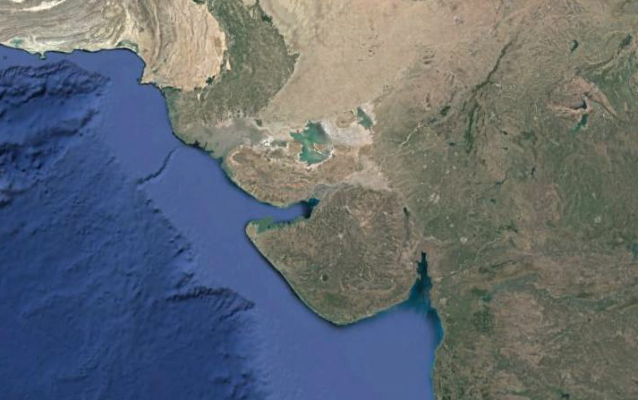
At the north-westernmost tip of the Kathiawar peninsula is the town of
Dwarka, legendarily associated with Krishna. Krishna is believed to have
reclaimed land from the sea for building Dwarka. Again, after his demise, the
city is believed to have been cataclysmically swallowed by the sea.
Present-day Dwarka may go back only to Mauryan times. Offshore
investigations also revealed many underwater structures and stone
anchors, indicating an ancient port, now submerged. Significantly, on the island of Bet Dwarka, 30 km away,
the former director-general of the Archaeological Survey of India (ASI), S R
Rao discovered the remains of a late Harappan site, with settlement commencing
at least about 1700 BCE. Rao himself believed he had discovered the historical Dwarka. However,
there may be good reason to believe it may all go much further back in time
than that.
The Eventful Geological History Of India’s Western Coast
The grand Harappan city of Dholavira in Gujarat was struck by a major
earthquake around 2200 BCE. The city was surrounded by unusually thick walls,
ostensibly to protect it from massive tsunamis, which seem to have deluged the Gujarat coast repeatedly, the earliest
known one being from about 6000 BCE.
There is considerable geological evidence pointing to neotectonic events
on the Saurashtra-Maharashtra coast, which may have led to rapid uplift or
subsidence of land. Take the instance of the carbonate deposits off the
Mumbai-Saurashtra coast. The remarkably even surface of this feature forms a
submarine terrace, with a size three-quarters the area of Kerala, at a depth of
about 90 metres (or fifty fathoms – a fathom is about six feet) from the sea
level, giving it the name, fifty fathom flat (FFF).
(Incidentally, it is on the FFF that the Bombay High oilfield is located.) By dating the deposits, geologists found that shallow sea conditions prevailed on this platform about 8,300 years ago. However, at that time, the eustatic sea level was only about 25 metres lower than today (see figure 4.33 here), implying that this large feature subsided after about 6300 BCE owing to tectonic events. Similar indications of tectonic subsidence in the Holocene were also obtained from the submarine carbonate terraces (which are up to 2 km wide) on the continental slope off Saurashtra-Mumbai, found at depths greater than 100 metres (those interested in detail may see figures 2 and 3 here).
(Incidentally, it is on the FFF that the Bombay High oilfield is located.) By dating the deposits, geologists found that shallow sea conditions prevailed on this platform about 8,300 years ago. However, at that time, the eustatic sea level was only about 25 metres lower than today (see figure 4.33 here), implying that this large feature subsided after about 6300 BCE owing to tectonic events. Similar indications of tectonic subsidence in the Holocene were also obtained from the submarine carbonate terraces (which are up to 2 km wide) on the continental slope off Saurashtra-Mumbai, found at depths greater than 100 metres (those interested in detail may see figures 2 and 3 here).
Equally, in this region, offshore dates from such submerged features
like the FFF are at least 8,000 years old, while features like oyster reefs
located a few metres above sea-level on the present-day shore too have yielded
dates of about 8,000 years. Thus, one can safely conclude, the local sea-level
had already reached, or slightly exceeded, the present day sea-level by about
6000 BCE. However, the eustatic sea-level then was at a depth of 24 metres from
what it is today. This implies the coast had undergone a tectonic uplift around
about 6000 BCE.
The local sea level on the Saurashtra coast reached a high somewhere in
the mid-Holocene, when it was, in places, several metres higher than today.
Many kilometres inland from the present-day shore were submerged, before the
sea receded to its present level around 4000 BCE. The dates may vary based on
local conditions, but such events seem to have been frequent in that region.
For instance, the estuary region of the Mahi River that flows into the Gulf of
Khambhat was submerged between 3,600 and 1,700 years ago owing to the higher
sea-level, and later rose by subsequent tectonic uplift. Geologist Merh writes that “…the Holocene sea oscillated above and below the present level
several times in the course of the last 6000 years”.
The Rann of Kachchh was under several metres of water till as recently
as 2000 BCE. Dholavira, located in the Rann, probably served as a port, and
went into decline when this function was lost with the sedimentation and uplift
of the Rann. Many other Harappan ports – such as Lothal – too became
dysfunctional in similar ways, and are today located several kilometres inland.
What makes these facts significant is the discovery – by oceanographers,
not archaeologists – of a Neolithic city, possibly as old as the earliest known
Indus Valley settlements at Mehrgarh or Bhirrana, submerged at a depth of 40 metres in the Gulf of Khambhat. This discovery could potentially rewrite the proto-history of the
subcontinent, but not much further progress seems to have been made since its
discovery in 2002, owing partially to India’s lack of expertise in marine
archaeology, perhaps a lack of interest on the part of the successor to the
Union minister then in charge, Dr Murli Manohar Joshi, and, majorly, to modern
India’s disregard for its own history.
An episode of rapid uplift of land and marine regression may well be the
historical basis for the legend of Krishna having reclaimed land from the sea
for building Dwarka, just as its fabled destruction may be owing to an
earthquake or tsunami.
The picture of India’s western coast today has clearly not always been
the case throughout the Holocene, and is merely a snapshot in a complex
evolution. The traditional account of Dwarka clearly has its origin in a vivid
memory of historical events, as suggested by the wealth of geological evidence
of frequent tectonic events leading to uplift and subsidence, massive tsunamis,
and fluctuating sea levels, as well as the known impact such events had on
Harappan cities of that region, and the fact that ancient cities have indeed
been found submerged there. One can only hope the ASI enhances its capabilities
in marine archaeology, and undertakes extensive, rigorous investigations off
the western coast, for the exact location and historicity of Dwarka to be
conclusively established.
Strikingly, traditional accounts and popular legends pertaining to
distant regions of the subcontinent – The Sarasvati-Indus valley, coastal
Gujarat and the Kerala coast – appear to have a basis in historical events, as
suggested by geological data. For obvious reasons, the vital clues such
traditional accounts provide in reconstructing the history of India have been
deliberately ignored by prejudiced scholars who have monopolised the discourse
for many decades now; anyone who challenges the status quo –
and that includes even scholars of considerable stature – will
immediately invite labels like anti-rational, “saffron” and “Hindutvavadi”, and get
marginalised.
There are many other legends – notably that of Rama restraining the sea
to build a bridge to Lanka – which could benefit from a systematic
archaeological and geological investigation. How many readers know that surveys
by the ASI and the Geological Survey of India have not been carried out for
the Sethusamudram Project, even though they are mandatory by law for any such project anywhere in
India? Every region of India has its own popular legends that have been orally
transmitted for millennia, and are not documented anywhere. We ignore these at the
peril of erasing our historical memory. The truth is not so much that our
ancestors were a people with a poor sense of history, but that we, in modern
times, have an unjustifiably poor opinion of our own sense of history.


No comments:
Post a Comment